
Key Takeaways
- Tides come from the Moon's gravity stretching Earth's oceans into two bulges, so most coasts get two high tides a day; the Sun adds about 46% of the Moon's tidal effect.
- Spring tides at new and full moons and smaller neap tides at quarter moons follow a roughly 14-day cycle.
- The Bay of Fundy has the world's largest tidal range — up to 16.3 metres recorded at Burntcoat Head — because the basin's natural rocking period nearly matches the tide's rhythm.
Why are there two high tides every day?
Stand on almost any coast and the sea will rise and fall twice a day, about six hours apart. The usual explanation — "the Moon's gravity pulls the water" — only gets you one high tide. The real mechanism is subtler and stranger: the Moon doesn't just pull the ocean, it stretches it.
Gravity weakens with distance, so the Moon pulls hardest on the water directly beneath it, less on the Earth itself, and least on the water on the far side of the planet. The result is two bulges in the ocean — one facing the Moon, pulled toward it, and one on the opposite side, where the water is effectively left behind. As the Earth rotates through those two bulges, your coastline passes through each in turn: high tide, low tide, high tide, low tide, roughly every 24 hours and 50 minutes.
The Sun helps — but the Moon runs the show
The Sun's gravity on Earth is about 177 times stronger than the Moon's. Yet its effect on the tides is only about 46% of the Moon's. The trick is that tides depend not on gravity's strength but on how much it changes across the planet — and that difference falls off with the cube of the distance. The Moon, being so much closer, wins.
When the Sun, Moon and Earth line up — at new moon and full moon — the two effects add together, producing the extra-high spring tides (the name has nothing to do with the season). When the Sun and Moon pull at right angles, at the quarter moons, they partly cancel, giving the smaller neap tides. The whole cycle repeats roughly every 14 days.
Why Canada's tides are the world's most extreme
If tides were just about the Moon, every coast would rise by roughly the same modest amount. Instead, the range depends on the shape of the basin the water sloshes in — and no basin on Earth amplifies the slosh like the Bay of Fundy. The Canadian Hydrographic Service puts the world's largest tidal range at 16 metres on Canada's East Coast; at Burntcoat Head in Nova Scotia, the recorded extreme is 16.3 metres, with an average spring range of 14.5 metres — the height of a four-storey building, twice a day.
Fundy's secret is resonance. The Gulf of Maine–Bay of Fundy system has a natural rocking period of about 13.3 hours, uncomfortably close to the 12.42-hour rhythm of the main lunar tide — like pushing a swing at almost exactly its natural pace. The bay's funnel shape then squeezes that amplified water higher still. The same physics produces Fundy's party tricks: the tidal bore that races up the Petitcodiac River, standing up to about four feet high, and Saint John's Reversing Falls, where the tide is so strong it pushes a river backwards over its rapids.
Elsewhere, geography can mute the Moon instead. The Mediterranean is nearly cut off from the Atlantic by the Strait of Gibraltar, only about 14 kilometres wide, so the ocean's tide can barely get in — most Mediterranean coasts see tides of just 10 to 40 centimetres.
The Twikup Take
Tides look like the sea breathing in and out. They are really the whole planet being gently stretched by a small, close Moon — and in the Bay of Fundy, a coastline shaped like a tuning fork turning that whisper into the loudest tides on Earth.
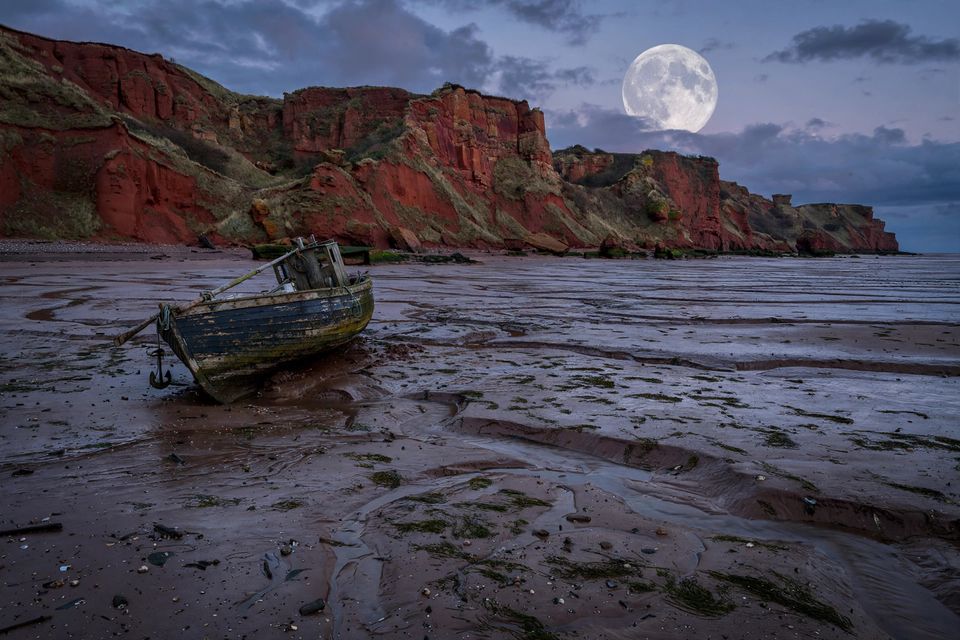
Image: Illustrative image.