
Key Takeaways
- CMHC's projections point to fewer housing starts in 2027 and 2028 than in 2025, creating a potential risk for future supply.
- The slowdown is not uniform: condominium construction faces particular pressure in Ontario and British Columbia, while some Prairie markets have performed more strongly.
- A construction slowdown does not guarantee rising prices because borrowing costs, employment, population growth and unsold inventory also influence buyers' decisions.
Could Canada's Housing Supply Become Tighter in 2027?
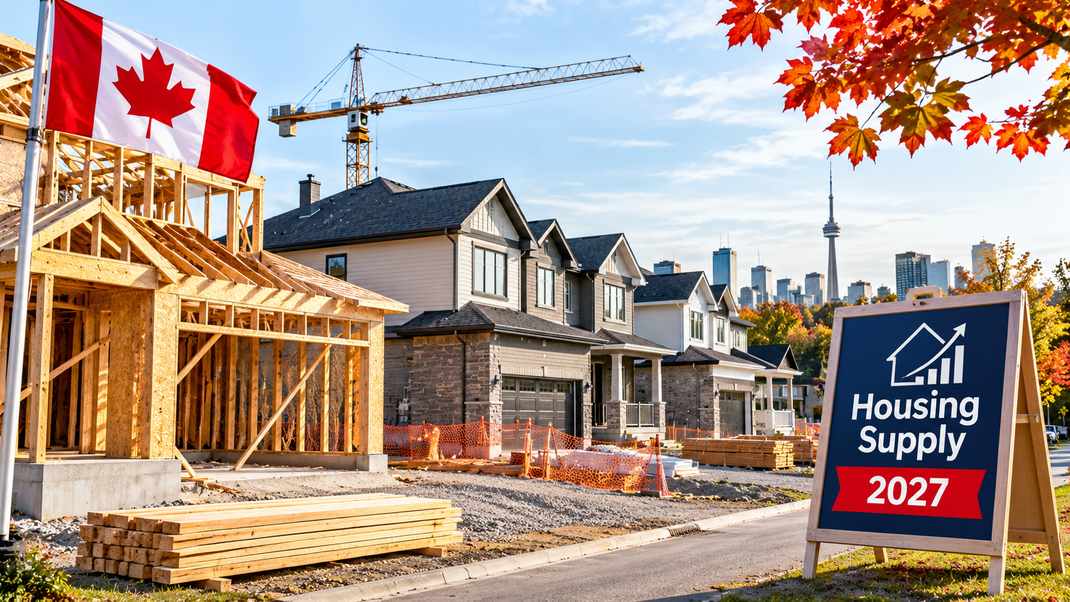
Canada housing supply 2027 is becoming an important concern as developers face weaker presales, elevated construction costs and unsold inventory. If fewer projects begin during the current market slowdown, the country could have fewer completed homes available when buyer demand improves.
However, slower construction does not automatically mean property prices will rise next year. Homes already under construction can still reach the market, while higher borrowing costs and cautious buyers can limit price growth. The bigger concern is whether today's reduction in new projects creates a shortage later.
How Many Homes Could Canada Build in 2027?
Canada Mortgage and Housing Corporation's 2026 Housing Market Outlook projected approximately 247,000 housing starts in 2026, followed by 223,000 in 2027 and 216,000 in 2028.
These figures are forecasts rather than confirmed construction totals. Still, they indicate that the development pipeline could weaken over several years.
CMHC's Fall 2026 Housing Supply Report also estimated an annual supply gap of 187,000 to 238,000 homes to restore pre-pandemic affordability by 2036. This is an estimated gap above projected construction, not the number of homes Canada currently lacks in one year.
The distinction matters. A country can record substantial completions today while still facing a future shortage if too few projects begin to replace the homes being delivered.
Why Are Canadian Developers Starting Fewer Projects?
Construction decisions depend on whether a project can attract buyers, secure financing and generate a reasonable return.
Several pressures are affecting developers:
- High construction costs: Labour, materials, land and financing can make new projects difficult to deliver profitably.
- Weak condominium presales: Developers often depend on presales to secure financing. Fewer committed buyers can delay or cancel projects.
- Unsold inventory: A large number of available units can discourage builders from adding similar properties.
- Borrowing costs: Expensive financing affects both developers and potential homebuyers.
- Uncertain demand: Slower population growth and economic uncertainty can make future sales harder to predict.
CMHC has identified these factors as reasons housing starts could remain below their historical average through 2028.
Which Canadian Regions Face Greater Supply Risks?
The construction outlook differs considerably by region.
Ontario: Ontario faces particular pressure from weaker condominium development. CMHC expects overall starts to approach two-decade lows in 2026, with a modest recovery projected for 2028. Toronto's ownership-oriented construction pipeline deserves close attention because fewer new condominium projects could limit future options for buyers.
British Columbia: CMHC expects housing starts to weaken significantly, reaching historically low levels by the end of its forecast period. High development costs and difficult project economics remain important challenges.
Alberta: Calgary has experienced stronger construction activity than several other major Canadian markets. CMHC reports that its estimated housing supply gap has narrowed significantly. Edmonton also stands out because CMHC identified it as the only large market in its assessment without a housing supply gap.
Quebec and Ottawa: CMHC reports that estimated supply gaps have widened in Montréal and Ottawa. Local construction activity and the mix of rental and ownership housing will influence how these markets develop.
These differences mean a national construction slowdown should not be treated as a prediction for every city.
Will Slower Construction Push Canadian Home Prices Higher?
It could contribute to upward pressure, but the timing depends on demand.
When fewer homes enter the development pipeline, the immediate effect may be limited because existing inventory and projects under construction can continue supplying the market. The impact becomes more significant if buyer demand strengthens before new construction can respond.
CREA's October 2026 forecast projected Canada's average home price at approximately $689,909 in 2027, representing a modest 1.2% increase from its 2026 forecast. This does not suggest an immediate nationwide price surge.
Prices will also depend on mortgage rates, household incomes, employment, population growth and the number of homes listed for sale. A city with abundant unsold inventory may experience limited price growth even when new construction slows.
Why Housing Starts and Completions Tell Different Stories
Housing starts measure projects where construction has begun. Completions measure homes that have finished construction and are ready for occupancy.
A decline in starts can therefore occur alongside strong completions. Developers may be finishing projects approved during an earlier period while launching fewer replacements.
This explains why buyers might still see new apartments and houses entering the market in 2027 even if the longer-term development pipeline is weakening.
Investors and homebuyers should also distinguish rental construction from ownership housing. A growing supply of purpose-built rental apartments does not necessarily solve a shortage of condominiums, townhouses or detached homes available for purchase.
TwikUp's Perspective
Canada's housing challenge is not simply about building fewer homes in one year. It is about whether construction can respond quickly enough when affordability improves and more households return to the market.
For buyers, a construction slowdown is not a reason to rush into a purchase. Compare local listings, completed inventory, planned developments and financing costs before making a decision. For investors, the type of housing being built matters as much as the total number of units.
Readers can explore our Ontario housing market forecast for 2027 and Alberta real estate forecast comparing Calgary and Edmonton for a closer look at two very different regional markets.
The important question is not whether construction is slowing everywhere. It is whether the homes being built match the locations, prices and property types that Canadians will need next.
Disclaimer
This article is for educational and informational purposes only. Housing forecasts are estimates, not guarantees of future prices or construction activity. Local market conditions can differ significantly. Readers should review current market data and seek qualified financial or real estate advice before making property decisions.