
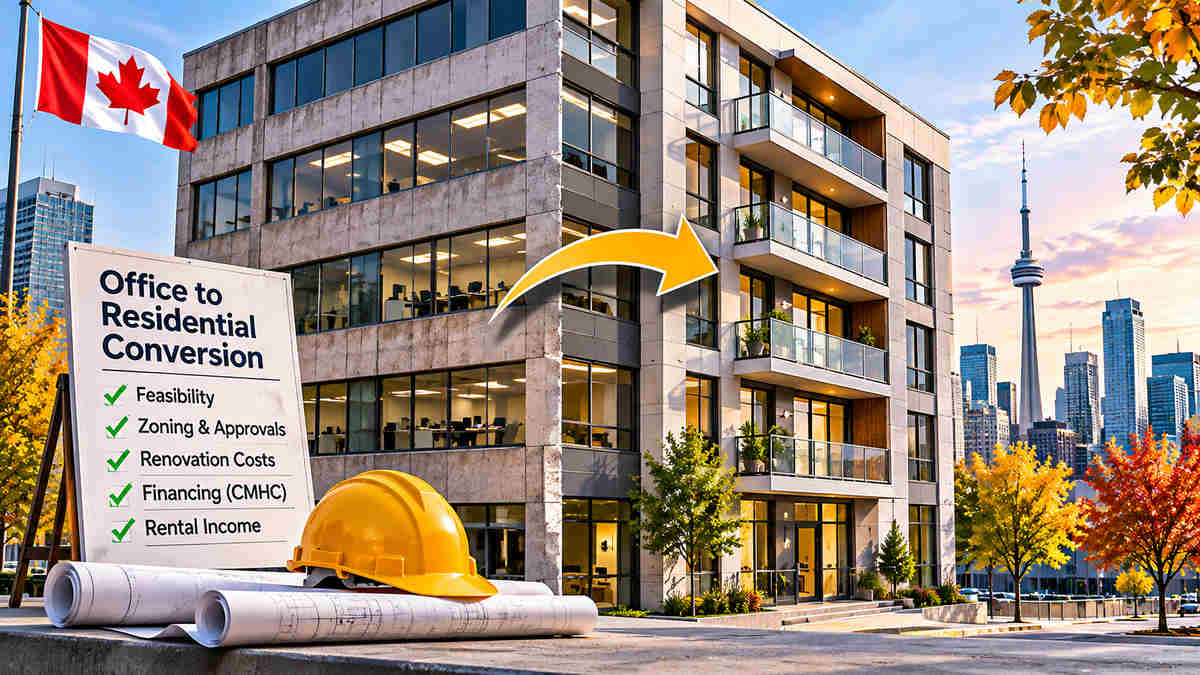
Key Takeaways
- Buildings with suitable floor plates, window placement and existing infrastructure can offer better conversion prospects than deeply configured office towers.
- Government support and construction financing may improve project feasibility, but funding availability and eligibility differ across programmes.
- Investors should compare the completed property's potential value with acquisition, construction, financing and approval costs before committing capital.
Can Empty Canadian Office Buildings Become Profitable Apartments?
Yes, some vacant office buildings in Canada can become profitable rental apartments, but the opportunity depends heavily on the building and its purchase price. An office tower with suitable windows, manageable floor depths, adaptable plumbing and residential zoning potential may offer a redevelopment opportunity. Another building only a few streets away could require such extensive structural work that conversion becomes financially impractical.
For investors considering office to residential conversion Canada in 2027, the important question is not simply how much empty office space exists. It is whether the cost of creating apartments is lower than the value those completed homes can realistically generate.
Why Are Investors Looking at Office Conversions?
Remote and hybrid working changed demand for many traditional office properties. Some older buildings struggled to attract tenants, leaving owners with expensive operating costs and weaker rental income.
Converting suitable buildings into apartments can give these properties a different purpose while adding housing in established urban neighbourhoods.
The trend is already visible in Canadian commercial property data. CBRE reported that office conversions had removed approximately 9.6 million square feet from national office inventory since 2021 by the third quarter of 2026. Another 3 million square feet had been demolished.
However, these figures include conversions to different uses, not residential apartments alone. Hotels and other redevelopment projects are also part of the trend.
Which Office Buildings Are Suitable for Residential Conversion?
Building design is one of the first things investors should examine. Residential apartments need natural light, suitable window access, functional layouts and adequate space for kitchens, bathrooms and mechanical systems.
A building with a simple rectangular floor plate may be easier to divide into individual apartments than a deep office tower with large interior areas far from external windows.
Other important considerations include:
- Floor plate and windows: Can individual apartments receive sufficient natural light and meet applicable building requirements?
- Plumbing infrastructure: Can bathrooms, kitchens and drainage systems be installed without extensive structural changes?
- Elevators and access: Can existing elevators, corridors and entrances support residential occupancy?
- Mechanical systems: Will heating, ventilation, cooling and electrical systems need substantial replacement?
- Location: Are public transit, grocery stores, healthcare facilities and everyday services nearby?
CMHC's research on converting vacant offices into homes identifies building layout, location, natural light and infrastructure upgrades as important considerations. A property should undergo a technical assessment before an investor assumes its office space can become housing.
How Can Investors Evaluate Conversion Profitability?
The financial assessment should begin before the building is purchased.
Investors need to estimate the total development cost, including acquisition, professional fees, construction, permits, financing, taxes, contingency reserves and marketing or leasing expenses.
A simplified feasibility formula is:
Potential Development Profit = Completed Property Value − Total Project Cost
Consider a hypothetical Canadian office building:
- Purchase price: CAD $8 million
- Construction and renovation: CAD $12 million
- Professional fees and approvals: CAD $1 million
- Financing and other project costs: CAD $2 million
- Contingency allowance: CAD $2 million
Total estimated project cost: CAD $25 million.
If the completed rental property is valued at CAD $29 million, the indicative difference is CAD $4 million before any additional costs or adjustments not included in the assumptions.
This is not a forecast or guaranteed return. The final result could change considerably if construction becomes more expensive, approvals take longer or apartment rents are lower than expected.
Investors should also calculate the completed property's expected net operating income and compare it with the total development cost. A project that appears profitable based on its estimated resale value may still produce disappointing rental returns.
Can Government Programmes and CMHC Financing Help?
Financing support can make otherwise difficult projects more achievable, although investors must understand the conditions attached to each programme.
Calgary provides one of Canada's clearest examples. Its Downtown Office Conversion Program supports eligible projects that transform underused office buildings into residential units and other approved uses.
The City's updated 2026 programme reported 21 supported projects representing 2,667 residential units in its conversion pipeline. Its latest application window closed in July 2026, so investors should not include this funding in a project budget unless future eligibility and availability are confirmed.
CMHC's Apartment Construction Loan Program also supports the conversion of non-residential buildings into standard rental housing. Financing is subject to programme eligibility, project underwriting and application requirements.
These programmes can improve the financial structure of a project, but they do not automatically make an unsuitable building viable.
What Risks Could Make an Office Conversion Unprofitable?
The biggest danger is underestimating the work required to transform commercial space into compliant housing.
Older office buildings may need new plumbing, electrical systems, elevators, windows, fire-safety improvements and heating infrastructure. Construction can also uncover hidden problems that were not obvious during the initial inspection.
Planning and approval delays create another financial challenge. Investors may continue paying property expenses and financing costs while waiting for permission to begin or complete construction.
There is also a market risk. An apartment building may be completed in an area where rental demand is weaker than expected or where competing developments offer newer facilities at attractive rents.
Finally, not every vacant office building should be converted. CBRE recorded positive national office absorption for five consecutive quarters by Q3 2026. Improving demand for certain office properties means investors must compare conversion with alternative uses, including leasing, refurbishment or selling the existing building.
TwikUp's Perspective: The Purchase Price Determines the Opportunity
Office redevelopment can also create opportunities to rethink existing parking areas and supporting infrastructure. Property owners with suitable parking spaces and electrical capacity may explore additional income opportunities through EV charging station investment in Canada. However, this depends on location, electricity access, installation costs and operator demand. Read our guide on Canada EV Charging Station Investment 2027: Can Landowners Earn Rental Income? to understand how commercial property owners can evaluate EV charging partnerships.
Disclaimer
This article is for general educational and informational purposes only. It does not constitute financial, legal, tax or investment advice. Office conversions involve development, construction, financing, regulatory and rental-market risks. Investors should obtain independent legal, engineering, planning and financial advice before acquiring or redeveloping a property.