
Key Takeaways
- Grocery tenants can support neighbouring businesses by attracting customers who visit frequently for everyday purchases.
- A property with a long supermarket lease may still carry substantial concentration risk if one company generates most of its rental income.
- Purchase decisions should account for replacement costs, vacant-space downtime and financing obligations, not just the advertised capitalization rate.
Why Are Grocery-Anchored Retail Properties Attracting Investors?
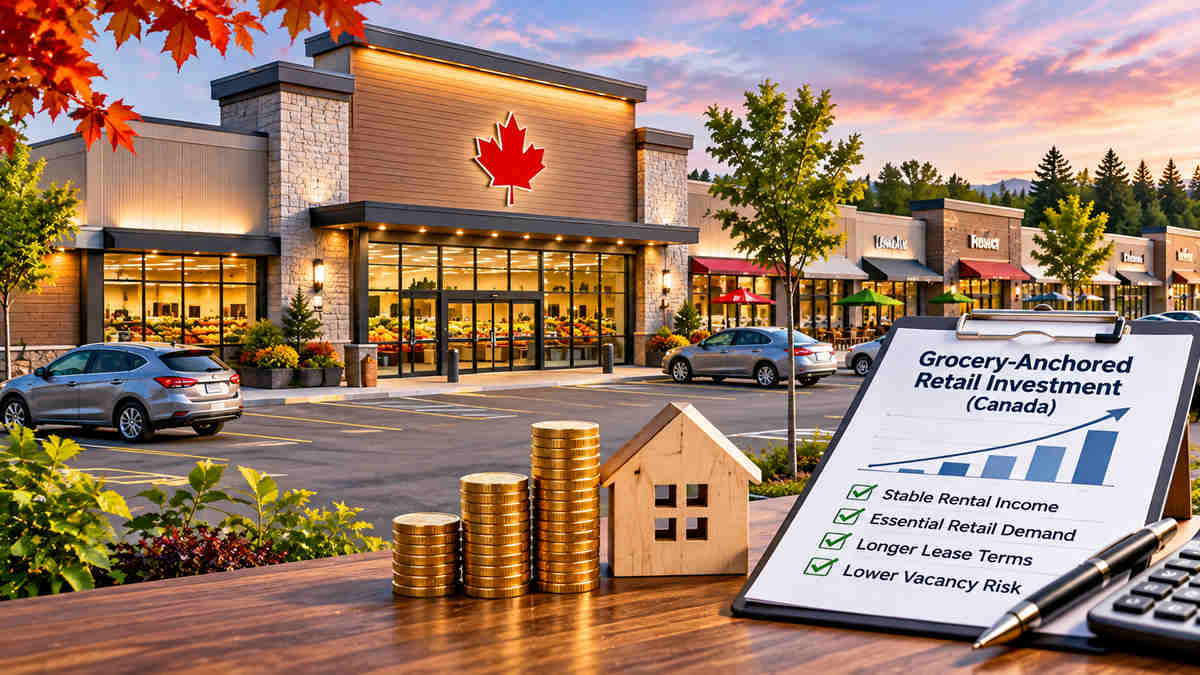
A shopping plaza built around a supermarket has a practical advantage: people need groceries throughout the year. This recurring demand can help attract visitors to nearby pharmacies, restaurants, medical clinics and convenience stores. For Canadian property investors, that creates an opportunity to earn rental income from a centre serving everyday neighbourhood needs.
However, grocery anchored retail investment Canada is not automatically a low-risk strategy. A supermarket may bring consistent traffic, but the property's financial performance still depends on lease agreements, tenant strength, location, purchase price and ongoing expenses.
The real question for 2027 is whether the supermarket's presence translates into dependable net operating income after the landlord pays the bills.
How Does a Supermarket Anchor Support Rental Income?
Grocery-anchored centres generally combine a supermarket with smaller tenants offering complementary products and services. Customers visiting the anchor store may also stop at a pharmacy, coffee shop, bakery or personal-care business.
This arrangement can make smaller units more attractive to tenants because they benefit from the supermarket's customer traffic. It can also give landlords several sources of rental income instead of relying entirely on one retailer.
Canadian market conditions provide some support for this property format. CBRE reported tight vacancy in grocery-anchored centres during the first half of 2026, particularly in suburban locations supported by population growth and tenant demand.
Yet investors should distinguish between customer traffic and rental income. A busy supermarket does not automatically guarantee that neighbouring units will remain occupied or pay profitable rents.
What Does the Canadian Market Signal for 2027?
Institutional interest offers another indication of the sector's appeal. In November 2026, Crombie REIT announced an agreement to acquire the remaining interest in 15 grocery-anchored necessity-based retail properties.
The portfolio was reported as fully occupied, with a weighted average lease term of approximately 15.9 years. Around 98% of its annual minimum rent was associated with Empire and its grocery banners. The proposed acquisition was subject to customary closing conditions.
This example demonstrates both the attraction and the potential weakness of the model. Long leases can support income visibility, but heavy dependence on one corporate tenant creates concentration risk.
Statistics Canada's September 2026 retail data also deserves attention. Supermarkets and other grocery retailers generated approximately CAD $9.465 billion in monthly sales, up 0.4% year over year in current dollars. Essential shopping demand remained substantial, although the modest increase does not suggest unlimited growth.
How Should Investors Calculate a Property's Income Potential?
A property's capitalization rate provides a starting point for comparing its income with its purchase price.
The formula is:
Cap Rate = Annual Net Operating Income ÷ Property Value × 100
Consider a hypothetical grocery-anchored plaza generating CAD $600,000 in annual net operating income. If the asking price is CAD $10 million, the capitalization rate is:
$600,000 ÷ $10,000,000 × 100 = 6%
This 6% figure is an illustrative calculation, not a recommended market benchmark or guaranteed return.
Investors should also calculate income after financing costs, capital improvements and other ownership obligations. Net operating income generally excludes mortgage payments, so a property showing a reasonable cap rate can still produce weak cash flow when purchased with expensive debt.
A buyer should request a rent roll, historical operating statements, lease documents and a schedule of upcoming repairs before accepting the seller's income projections.
Which Supermarket Lease Details Matter Most?
The supermarket lease deserves close attention because it may determine the financial strength of the entire centre.
Check the remaining lease term, renewal options, contractual rent increases, permitted uses and responsibilities for maintenance. Investors should also examine assignment rights, termination clauses and any conditions allowing the tenant to leave before the stated expiry date.
Co-tenancy provisions require particular care. Some smaller retailers may have rights to reduce rent or terminate their leases if the anchor supermarket closes or stops operating. Such clauses can turn one vacancy into several.
Another important consideration is the difference between a supermarket's brand and the legal entity signing the lease. A recognizable banner does not automatically mean the property owner has a direct guarantee from a financially strong parent company.
What Risks Could Reduce Returns?
The biggest risk is losing the anchor tenant. Replacing a supermarket can take time because another operator may require a different floor plan, refrigeration equipment, loading facilities or parking arrangements.
The landlord may also need to fund renovations, tenant improvements and leasing commissions. During the vacancy period, the property could lose its main source of rental income while mortgage payments, insurance and taxes continue.
Other risks include competition from nearby supermarkets, changing neighbourhood demographics, property tax increases, roof and parking repairs, environmental issues and rising borrowing costs.
Investors should also investigate whether the supermarket has recently renovated, expanded or announced plans to remain in the location. These details can help assess tenant commitment, although they cannot replace a review of the signed lease.
TwikUp's Perspective: Buy the Lease, Not Just the Supermarket Sign
TwikUp believes the strongest investment cases will come from properties where the anchor tenant, surrounding businesses and local population support one another. A supermarket with a long lease can be valuable, but the surrounding centre should remain commercially useful even if that tenant eventually changes.
There may also be opportunities to generate additional income from the same commercial property. For example, owners with suitable parking areas could explore EV charging station investment in Canada as a complementary revenue opportunity. However, charging infrastructure should be evaluated separately, particularly for electricity capacity, installation costs, parking availability and lease responsibilities.
Before buying, investors should model at least two situations: normal operations with the supermarket paying rent, and a downside scenario involving anchor vacancy and replacement costs. The difference between those outcomes reveals how much risk is hidden behind the advertised income.
Disclaimer
This article is for general educational and informational purposes only. It does not constitute financial, investment, legal or tax advice. Commercial real estate investments involve risks, including tenant defaults, vacancies, financing costs, property repairs and changes in market conditions. Readers should conduct independent due diligence and consult qualified professionals before making investment decisions.