
Key Takeaways
- A distressed sale can create an attractive entry price, but the underlying building may carry expensive operational or legal problems.
- The strongest opportunities usually involve identifiable demand and a realistic plan to improve the property's income or usefulness.
- Investors should calculate the full acquisition and recovery budget before comparing a discounted price with market value.
Could Distressed Commercial Property Investment Work in Canada in 2027?
Distressed commercial real estate in Canada could offer opportunities for investors in 2027, particularly when financial pressure forces an owner to sell a property below its potential market value. However, a lower purchase price does not automatically create a profitable investment. The real opportunity depends on whether the building can attract tenants, generate sustainable income or support a financially realistic redevelopment plan.
Distressed properties can include vacant office buildings, struggling retail centres, underperforming industrial facilities and assets sold through receivership, foreclosure or other creditor-related processes. Each category has different risks, so investors should evaluate the property rather than assume every discounted building is worth buying.
Why Are More Investors Watching Distressed Commercial Properties?
Financial pressure can push property owners to sell when they cannot comfortably manage mortgage payments, operating expenses, upcoming loan renewals or major repair bills. In some cases, lenders or court-appointed receivers become involved in the sale process.
Altus Group data reported in 2026 showed 252 distressed-sale transactions in Canada during 2025, compared with 191 in 2024. The reported value was more than CAD $1.42 billion in 2025. These figures indicate increased transaction activity, although the definition focuses on court-related sales and does not capture every discounted private transaction.
The wider commercial property market is not uniformly distressed. Industrial and selected retail assets have attracted investor interest, while some office properties continue to face challenges. This difference matters because a building in a sector with active tenant demand may have a clearer recovery route than one facing a long-term decline.
Which Distressed Commercial Properties Could Offer Opportunities?
Older office buildings may attract investors who can improve the layout, upgrade building systems or consider a change of use. However, conversion is not always practical. Floor plates, windows, plumbing, structural conditions and municipal approvals can determine whether a new use is financially achievable.
Retail properties may offer potential when they serve established neighbourhoods and have suitable parking, access and visibility. A struggling centre with strong local demand could be repositioned, but weak foot traffic or an unsuitable tenant mix can make recovery difficult.
Industrial properties deserve a different assessment. Warehouses and smaller industrial buildings may appeal to businesses seeking storage, distribution or production space. Investors should examine loading facilities, ceiling height, electrical capacity, truck access and the local supply of competing properties.
How Should Investors Calculate the Real Purchase Cost?
The advertised discount is only one part of the investment calculation. Buyers should estimate the complete cost of acquiring, repairing, financing and operating the property before deciding whether the opportunity makes sense.
Consider a hypothetical commercial building with an estimated comparable market value of CAD $5 million. A distressed seller accepts CAD $3.8 million. At first glance, the buyer appears to receive a CAD $1.2 million discount.
However, assume the property also requires CAD $450,000 in repairs, CAD $120,000 in legal and professional costs, CAD $180,000 in financing and holding expenses, and CAD $250,000 for leasing and tenant improvements.
The estimated total commitment becomes:
- Purchase price: CAD $3,800,000
- Repairs: CAD $450,000
- Legal and professional costs: CAD $120,000
- Financing and holding expenses: CAD $180,000
- Leasing and tenant improvements: CAD $250,000
- Total estimated investment: CAD $4,800,000
The apparent CAD $1.2 million discount has narrowed to CAD $200,000 before any unexpected costs, taxes or future selling expenses. If the building takes longer to lease or requires additional work, that remaining margin could disappear.
This example is illustrative, not a property valuation or forecast.
What Due Diligence Should Buyers Complete?
Start by confirming the legal ownership, registered mortgages, liens, easements, unpaid property taxes and other title matters. A receivership or lender-directed sale may have specific conditions, deadlines and limitations. Buyers should have a commercial real estate lawyer review the sale documents and explain which obligations may remain after closing.
Next, commission appropriate building inspections and environmental assessments. Older commercial sites may have roof deterioration, structural problems, outdated electrical systems, asbestos-containing materials or soil contamination. A low purchase price offers little protection if remediation or replacement work becomes expensive.
Review the rent roll, lease agreements, tenant arrears, security deposits, operating expenses and upcoming lease expiries. A property that appears occupied may still produce weak cash flow if tenants are behind on payments or leases are close to ending.
Finally, confirm zoning, permitted uses, building-code requirements, insurance availability and realistic financing terms. Do not assume a lender will finance a distressed property on the same terms as a stable, fully leased building.
What Are the Biggest Risks of Buying a Distressed Building?
The first risk is an inaccurate assessment of repair costs. Deferred maintenance can conceal problems that are not obvious during a brief viewing. The second is weak tenant demand. Even a renovated building may struggle if businesses are leaving the area or comparable space is available at lower rents.
Financing also deserves attention. Some lenders may require larger equity contributions, stronger borrower qualifications or additional security for properties with high vacancy and uncertain income. Meanwhile, taxes, insurance, utilities and security costs can continue while the property remains empty.
Investors should also understand that sale processes differ by province and transaction structure. A receiver's sale, mortgage enforcement sale and ordinary private sale may involve different procedures and buyer protections. Independent legal advice is essential before submitting an offer.
TwikUp's Perspective
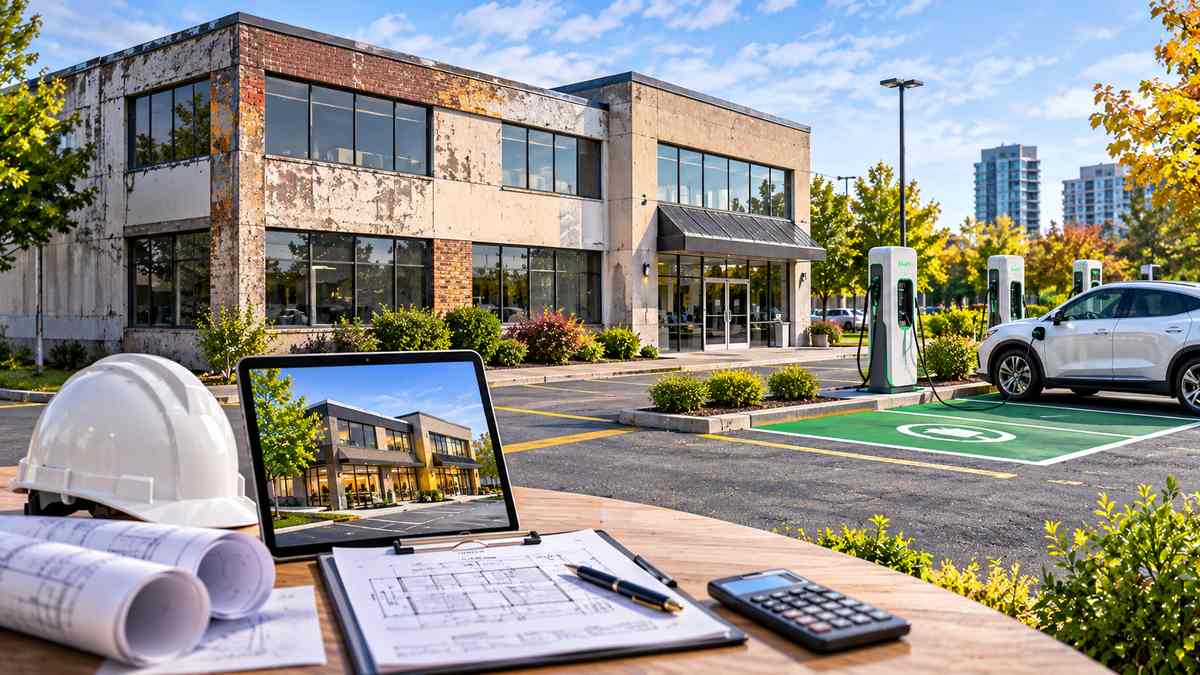
Investors evaluating distressed commercial properties should also examine whether existing parking areas could support additional revenue streams. Depending on local demand, electrical capacity, site access and installation costs, a suitable property may offer opportunities through EV charging station investment in Canada. Read our guide on Canada EV Charging Station Investment 2027: Can Landowners Earn Rental Income? to understand how landowners can assess charging infrastructure partnerships and potential rental income.
Disclaimer
This article is for general educational purposes only and does not constitute financial, legal, tax or investment advice. Commercial property purchases involve market, financing, environmental, legal and operational risks. Receivership and mortgage enforcement procedures vary by province and transaction. Consult qualified legal, financial, environmental and property professionals before investing.