
Key Takeaways
- The avalanche method prioritizes expensive borrowing, making it particularly useful when interest rates vary significantly between accounts.
- The snowball method can simplify household finances by eliminating smaller outstanding accounts and reducing the number of payments to manage.
- Your repayment budget must remain sustainable. An overly aggressive plan can create new borrowing when unexpected expenses arrive.
Debt Snowball vs Debt Avalanche: The Main Difference
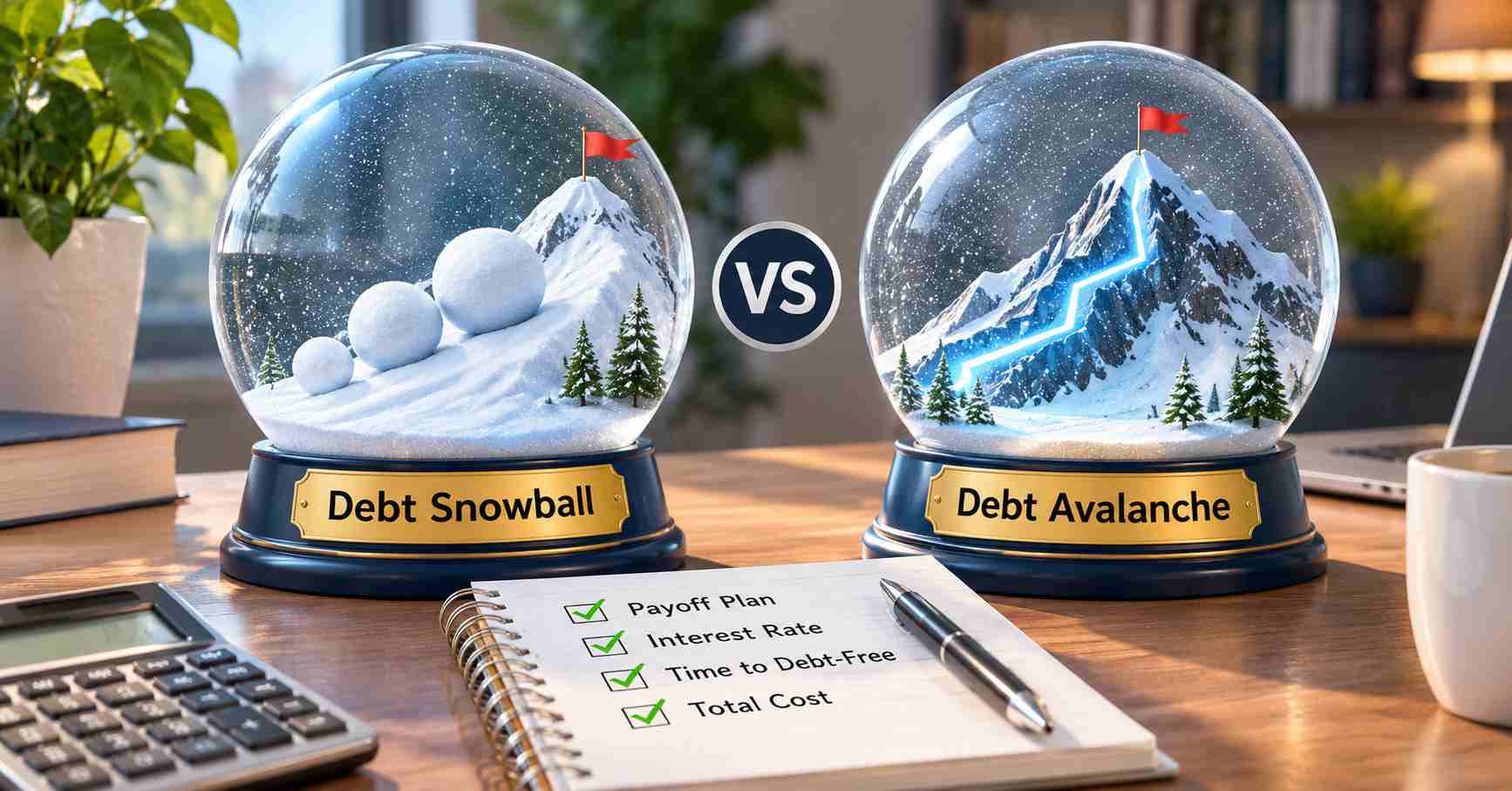
Both methods help people tackle several balances by directing extra money toward one debt at a time. The difference is the order. Snowball starts with the smallest balance; avalanche starts with the highest interest rate.
With either method, make at least the required minimum payment on every account. Put the money left in your debt budget toward one target. When that balance reaches zero, roll its payment into the next target. This builds a larger payment without increasing your monthly budget.
Avalanche usually costs less in interest and can clear the full debt load sooner when rates and payment assumptions remain equal. Snowball can produce earlier account payoffs, which may help someone stay consistent.
How the Debt Snowball Method Works
List debts from the smallest balance to the largest, regardless of interest rate. Pay the minimum on every account, then put all extra repayment money toward the smallest balance. Once it is cleared, add its former payment to the next-smallest debt. Continue until every balance is paid. The growing payment is the “snowball.”
This method can help when several small accounts feel overwhelming or you have struggled to maintain a plan. Closing an account creates a visible milestone. Research in the Journal of Consumer Research found that concentrating repayments on smaller accounts can increase motivation and encourage more aggressive repayment behaviour.
The trade-off is cost. A small balance charging 8% may be paid before a larger balance charging 24%. Meanwhile, the expensive debt continues accumulating interest.
How the Debt Avalanche Method Works
List debts from the highest annual interest rate to the lowest. Pay the minimum due on every account and direct all additional money to the highest-rate debt. After clearing it, move to the next-highest rate. Keep rolling the freed payment forward until all balances are gone.
Avalanche is the strongest mathematical choice when your goal is to minimize interest, assuming fees, promotional-rate changes or prepayment penalties do not alter the calculation. It targets the debt growing fastest relative to what you owe.
Its weakness is psychological. If the highest-rate debt is also your largest balance, it may take months to see an account disappear. Someone who loses motivation may stop making extra payments or return to borrowing.
A Worked Example: Which Method Costs Less?
Imagine three debts with a combined balance of $8,700:
| Debt | Balance | Annual interest rate |
|---|---|---|
| Store card | $1,200 | 18% |
| Personal loan | $3,000 | 12% |
| Credit card | $4,500 | 22% |
The snowball order is store card, personal loan, then credit card. The avalanche order is credit card, store card, then personal loan.
Assume a fixed repayment budget of $500 per month, constant rates, no new borrowing or fees, and a simplified minimum payment equal to the greater of $25 or 2% of each current balance. A monthly-interest simulation under these assumptions gives the snowball about 21 months to repay, with roughly $1,604 in interest. Avalanche takes about 20 months, with roughly $1,294 in interest.
That illustrative difference is about $310, not a lender quote. Actual results depend on minimum-payment formulas, compounding, payment dates, fees and rate changes. The lesson is that targeting the highest rate can reduce borrowing costs, even when snowball clears a small account earlier.
Which Strategy Should You Choose?
Choose avalanche if you can stay committed without frequent payoff milestones, your interest rates vary widely, or minimizing interest is your priority. It is especially compelling when a credit card balance costs much more than your other debts.
Choose snowball if several small balances weigh on you, early wins help you stay motivated, or reducing the number of monthly accounts would make your plan easier to manage. Paying somewhat more interest may be worthwhile if it helps you follow through.
A hybrid is also possible. Clear one very small balance first for a psychological boost, then switch to avalanche. Avoid changing methods repeatedly, as that can slow progress.
Before You Start: Protect the Repayment Plan
Bring overdue accounts current where possible before following either order. Past-due balances can trigger extra charges, collection activity and credit-file consequences. Keep every minimum payment on schedule; an aggressive target payment is not useful if it causes another account to become delinquent.
If you cannot afford minimum payments, contact creditors early and consider a reputable nonprofit credit counsellor or qualified adviser in your jurisdiction.
Canadian readers can consult the Financial Consumer Agency of Canada's repayment guidance. US readers can use the Consumer Financial Protection Bureau's debt-reduction worksheet to compare the highest-interest and snowball methods.
TwikUp's Perspective
The best repayment strategy is not simply the one that wins a spreadsheet comparison. It is the one that turns a fixed amount of monthly cash into consistent progress without forcing you to borrow again when an ordinary expense appears.
Treat motivation as part of the calculation, but put a price on it. If snowball costs only a modest amount more and makes you much more likely to stay on track, that trade may be sensible. If the interest gap is large, track monthly balances to build motivation while using avalanche.
Debt repayment is also part of a family's wider financial protection plan. Outstanding loans and other financial obligations can create pressure on loved ones if the primary earner dies unexpectedly. Understanding term life vs whole life insurance and which policy makes more financial sense can help families consider how life insurance may protect dependents from financial uncertainty.
Compare the actual rates, balances, minimums and fees on your statements. A realistic budget also matters; our guide to breaking the paycheque-to-paycheque cycle can help you find a sustainable amount for monthly repayments.
Disclaimer
This article is for general educational purposes only and is not individualized financial or debt-management advice. Interest rates, minimum-payment requirements, fees, loan agreements and consumer protections differ between financial institutions and jurisdictions. The numerical comparison is illustrative and does not guarantee a particular repayment period or interest saving.