
The Acceptance Email Is Just the Starting Line
Picture this: the acceptance email lands in your inbox. You screenshot it, send it to your family, and start dreaming about your new life in Canada.
Then reality taps you on the shoulder. That letter alone won't get you through the airport. The document that actually lets you study in Canada is a study permit — and getting one is a project of its own. Here's how it works.
First: What a Study Permit Is — and Isn't
A study permit is the document IRCC issues that lets a foreign national study at a designated learning institution (DLI) in Canada. If your program lasts more than six months, you need one.
Here's the part that trips people up: a study permit is not a visa. It gives you permission to study, not to enter the country. To travel to Canada, you also need a visitor visa (temporary resident visa) or an electronic travel authorization (eTA), depending on your passport. The good news: when IRCC approves a first study permit, it issues the visa or eTA automatically with it.
Step One: A Designated School and a Letter of Acceptance
You can't apply with just any school. Your institution must be a DLI — a school approved by its provincial or territorial government to host international students. IRCC publishes the official DLI list; checking your school is on it takes two minutes that can save your whole plan.
Once admitted, the school gives you a letter of acceptance (LOA) — always required, and IRCC will ask your school to confirm it is genuine.
Step Two: The Attestation Letter Nobody Expected
Since 2024, Canada caps study permits, and most applicants must prove they hold one of their province's spots. That proof is a provincial attestation letter (PAL) — or territorial attestation letter (TAL) — which you get through your school, usually after accepting your offer and paying some tuition. It must go in with your application, and one from a previous cap year won't work.
Some students are exempt. Since January 1, 2026, students in master's and doctoral programs at public DLIs no longer need a PAL/TAL. Primary and secondary students are exempt too, as are students extending a permit at the same school and level. Studying in Quebec? Different paperwork: you need a Quebec Acceptance Certificate (CAQ) instead.
Step Three: Show Me the Money
IRCC wants proof you can support yourself without working in Canada. For applications submitted on or after September 1, 2026, a single applicant studying outside Quebec must show $23,448 for one year of living expenses — on top of first-year tuition and travel costs to and from Canada. Family raises the bar: a family of four must show $43,572, plus $6,318 for each additional family member.
Bank statements, a GIC, an education loan or a sponsor's letter can all serve as proof. The fee itself is $150, plus $85 for biometrics.
Applying — Before You Fly
You apply online, and in most cases before you come to Canada. A permit is normally issued for your program's length plus 90 days — your window to wrap up, extend, or apply to stay and work. Careful: finish early, and the 90-day countdown starts from your completion date, not the date printed on the permit.
Working While You Study
Good news for the rent: eligible full-time students at a DLI can work off campus up to 24 hours per week during term — no separate work permit needed — and unlimited hours during scheduled breaks like summer holidays. You cannot start before your program begins, and working over the limit violates your permit conditions.
If your program requires a co-op placement or internship, the rules just changed in your favour: since April 1, 2026, post-secondary students no longer need a separate co-op work permit for a required placement, as long as it makes up 50% or less of the program.
After Graduation: The PGWP Bridge
The study permit's final gift is what comes next. Graduates of eligible programs at PGWP-eligible DLIs can apply for a post-graduation work permit (PGWP) — an open work permit whose length is tied to your program's. The essentials:
- Your program must have been at least 8 months long, studied mostly full-time
- Apply within 180 days of confirmation that you completed your program
- You can only ever get one PGWP
- Most graduates must now prove language skills — CLB 7 for degree graduates, CLB 5 for college graduates — and non-degree programs may face field-of-study requirements too
The Twikup Take
Canada's study permit is no longer a formality you handle after the celebration — it is a three-gate process (right school, attestation letter, serious money) that rewards whoever starts early and reads the current rules, not last year's blog post.
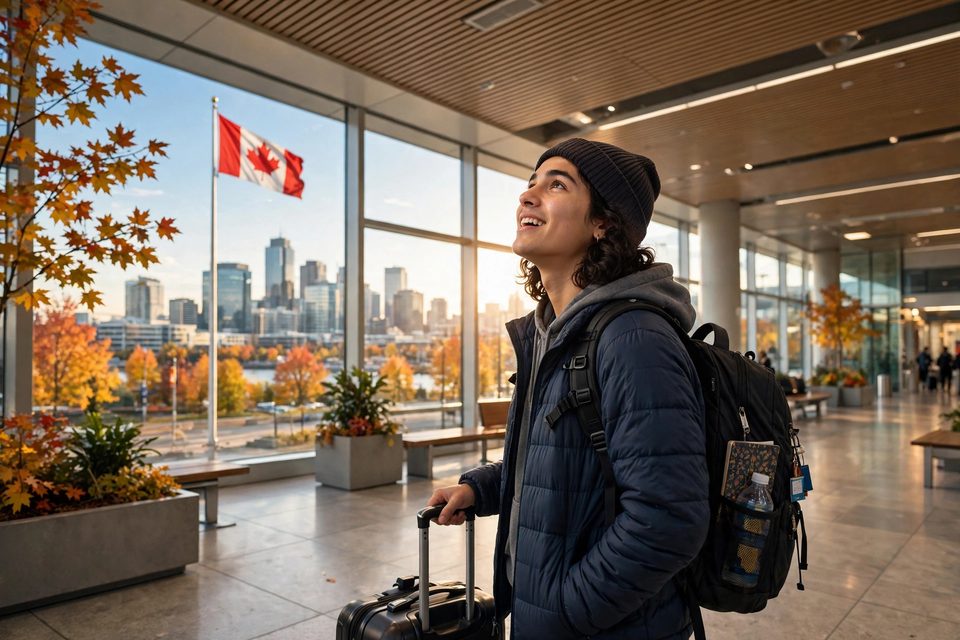
Image: AI-generated illustration.
Sources
- Immigration, Refugees and Citizenship Canada
- Immigration, Refugees and Citizenship Canada
- Immigration, Refugees and Citizenship Canada
- Immigration, Refugees and Citizenship Canada
- Immigration, Refugees and Citizenship Canada
- Immigration, Refugees and Citizenship Canada
- Immigration, Refugees and Citizenship Canada
- Immigration, Refugees and Citizenship Canada