
Key Takeaways
- PAHO's expert commission has determined the United States re-established endemic measles transmission, ending the elimination status it held since 2000.
- A single transmission chain that began on January 20, 2025 persisted for more than twelve months — the finding that cost the US its status.
- US cases reached 2,289 in 2025 and 5,412 by the end of October 2026, with 10 fatal; Canada also lost its status in 2025 and has not yet regained it.
The US held measles elimination status for 26 years — that run is over
The United States has lost its measles elimination status — a hard-won public health milestone it held since 2000. The Pan American Health Organization's Regional Monitoring and Re-Verification Commission, meeting in Washington from November 10 to 13, determined that the US has re-established endemic measles transmission.
Harvard Medical School's Rick Malley called it "a sad benchmark."
Elimination doesn't mean zero cases. It means no homegrown chain of transmission lasting more than twelve months. The US failed that test — a single chain that began on January 20, 2025 kept going past the one-year mark.
The numbers behind the decision
The scale is striking: US cases jumped tenfold from 2024 to 2,289 in 2025, then more than doubled to 5,412 by the end of October 2026, with 10 cases fatal. In ten separate weeks of 2026, the US recorded more than 200 new cases — a weekly total higher than the entire annual count in 23 of the past 30 years. Measles is one of the most contagious viruses known, infecting 12 to 18 people per case in an unprotected population.
What happens now
What happens now: the US must submit a corrective action plan to PAHO, and regaining elimination status requires more than twelve months with no endemic transmission. "We have safe and effective vaccines," Malley said, "and we know that if you start getting 92, 93 percent coverage, you will stop this disease in its tracks."
Health note
Canada is in the same boat: PAHO's letter notes Canada also re-established endemic transmission in 2025 and, while it has made significant progress controlling its outbreak, has not yet regained elimination status. Measles spreads through the air and can cause pneumonia, brain inflammation and death.
The Twikup Take
Elimination status sounds like a bureaucratic label, but it marks something real — a virus that was beaten back to imported cases only is now circulating on its own again in the US, and Canada lost the same status last year. The fix is unglamorous and known: coverage in the low-to-mid 90s, sustained, community by community.
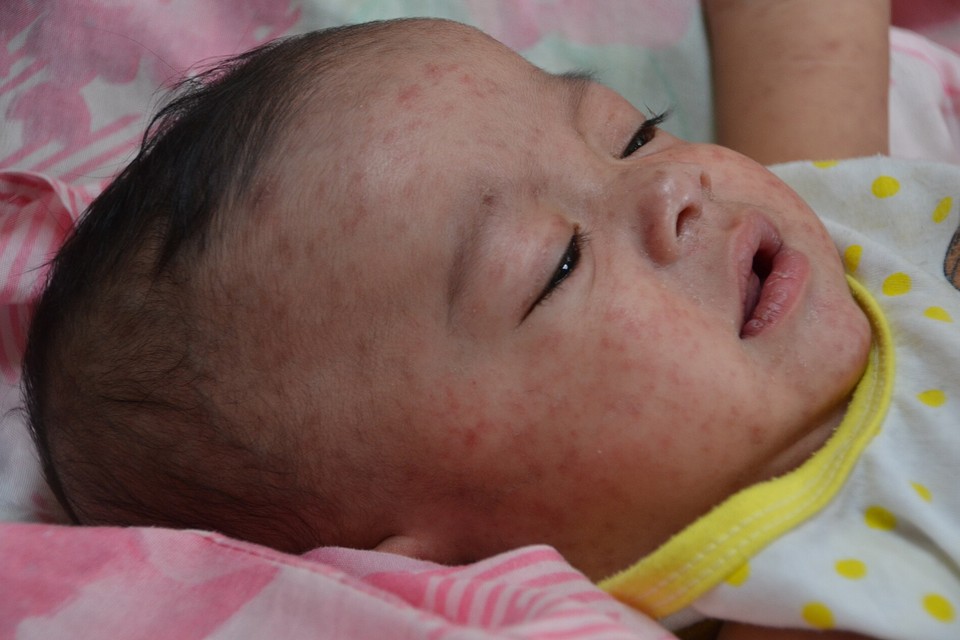
Image: A baby with measles in 2014 by CDC Global, Jim Goodson, M.P.H., Public domain. (https://commons.wikimedia.org/wiki/File:Measles_child_Philippines.jpg)