
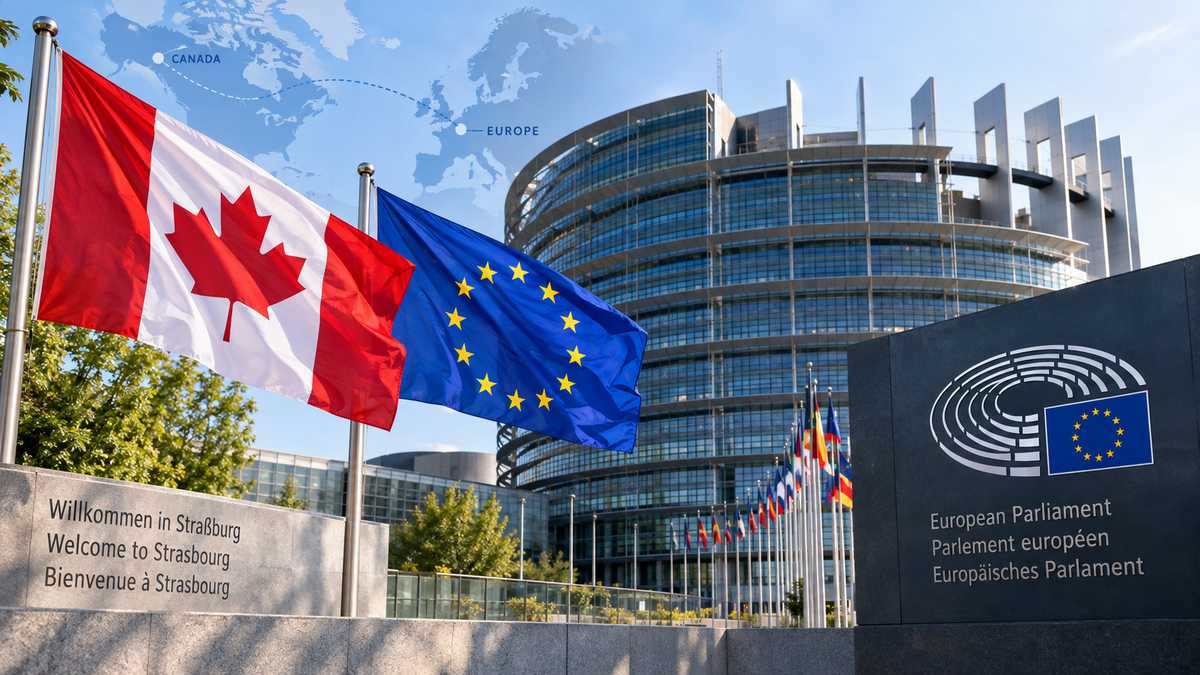
EU Proposes New Associate Membership Path for Canada
During her State of the European Union address, von der Leyen said Europe wanted to take its relationship with Canada to the highest level possible.
She proposed working with Canada on opening the door for the country to become the European Union's first associate member.
The proposal represents a new form of partnership between Canada and the EU.
The European Commission's speech also described plans to move from CETA toward what it called an Alliance for the Future, covering several areas of strategic cooperation.
Canada and Europe Look Beyond CETA
CETA has been the foundation of Canada-EU trade relations for several years.
The new proposal would seek to build a broader relationship around economic security, strategic capabilities and cooperation in areas that extend beyond traditional trade.
Prime Minister Mark Carney welcomed von der Leyen's proposal for Canada and the EU to move beyond CETA toward a stronger and more ambitious alliance.
The Canadian government's official readout said the two sides want to define this approach together, based on their complementary strengths and shared values.
Critical Minerals and Energy Among Key Areas
Critical minerals are expected to be an important part of the closer Canada-EU relationship.
Canada has significant resources that are important for batteries, advanced manufacturing and other strategic industries, while European countries are looking to strengthen supply chains and reduce strategic dependencies.
Energy security is another area identified by the two sides.
The discussions also cover defence industrial capacity, reflecting growing interest in strengthening strategic capabilities across the Atlantic.
AI and Advanced Technology Take Center Stage
Artificial intelligence and computing are also included in the proposed cooperation.
Canada and Europe are looking at ways to strengthen their technological capabilities while building greater strategic autonomy.
The European Commission's State of the Union address specifically highlighted technology cooperation, including AI, quantum computing and cybersecurity.
Canada's official readout similarly identified AI and compute, research and development and advanced technologies as areas where the partnership could deepen.
Space and Financial Services Also Included
The proposed relationship goes beyond defence and technology.
Canada and the EU are also discussing cooperation involving space, financial services and payments.
The Canadian government said the leaders discussed moving toward seamless digital trade in non-agricultural goods and a wide range of services.
These areas could expand the relationship beyond the existing trade framework and create new opportunities for businesses and institutions on both sides of the Atlantic.
What Does Associate Membership Mean?
The proposal does not mean that Canada is becoming a full member of the European Union.
Instead, von der Leyen proposed opening discussions toward an associate-member relationship.
The exact structure of such a relationship has not yet been defined.
Canada's official readout describes the broader approach as something that Canada and the EU will define together.
That means the proposal represents the beginning of a process rather than a completed membership arrangement.
Carney's European Strategy
The announcement comes during Prime Minister Mark Carney's September visit to Europe.
Canada has been seeking stronger relationships with European partners in trade, investment, defence and security.
Before the EU proposal, Carney had already described the goal as building a unique security and economic alliance with Europe.
The Canadian government has highlighted strategic autonomy as an important objective, particularly in areas such as AI, payments, space, critical minerals and clean energy.
Canada and the EU Share Strategic Interests
The European Commission said Canada and Europe already cooperate closely on trade, defence, raw materials and supply chains.
Von der Leyen also highlighted cooperation on Ukraine and shared democratic values.
The proposed Alliance for the Future would expand this cooperation into manufacturing, technology, defence, the Arctic, energy, critical minerals, batteries, AI, quantum technology, cybersecurity and economic security.
What Happens Next?
The associate-membership proposal is now expected to require further discussions between Canada and the European Union.
The two sides will need to define what the proposed relationship would involve and how it would operate.
For now, Canada's official position is focused on building a stronger alliance with Europe beyond CETA.
The European Commission's proposal adds another possible framework for that relationship, but the details have yet to be worked out.
A New Chapter in Canada-Europe Relations
The proposal marks a significant development in Canada's relationship with Europe.
Canada and the EU are already major trading and strategic partners, but both sides are now discussing a broader relationship covering defence, technology, energy, critical minerals, digital trade and economic security.
Whether the associate-member concept develops into a formal arrangement will depend on future negotiations.
For now, the focus is on defining a new Canada-Europe partnership and expanding cooperation across a much wider range of strategic areas.