
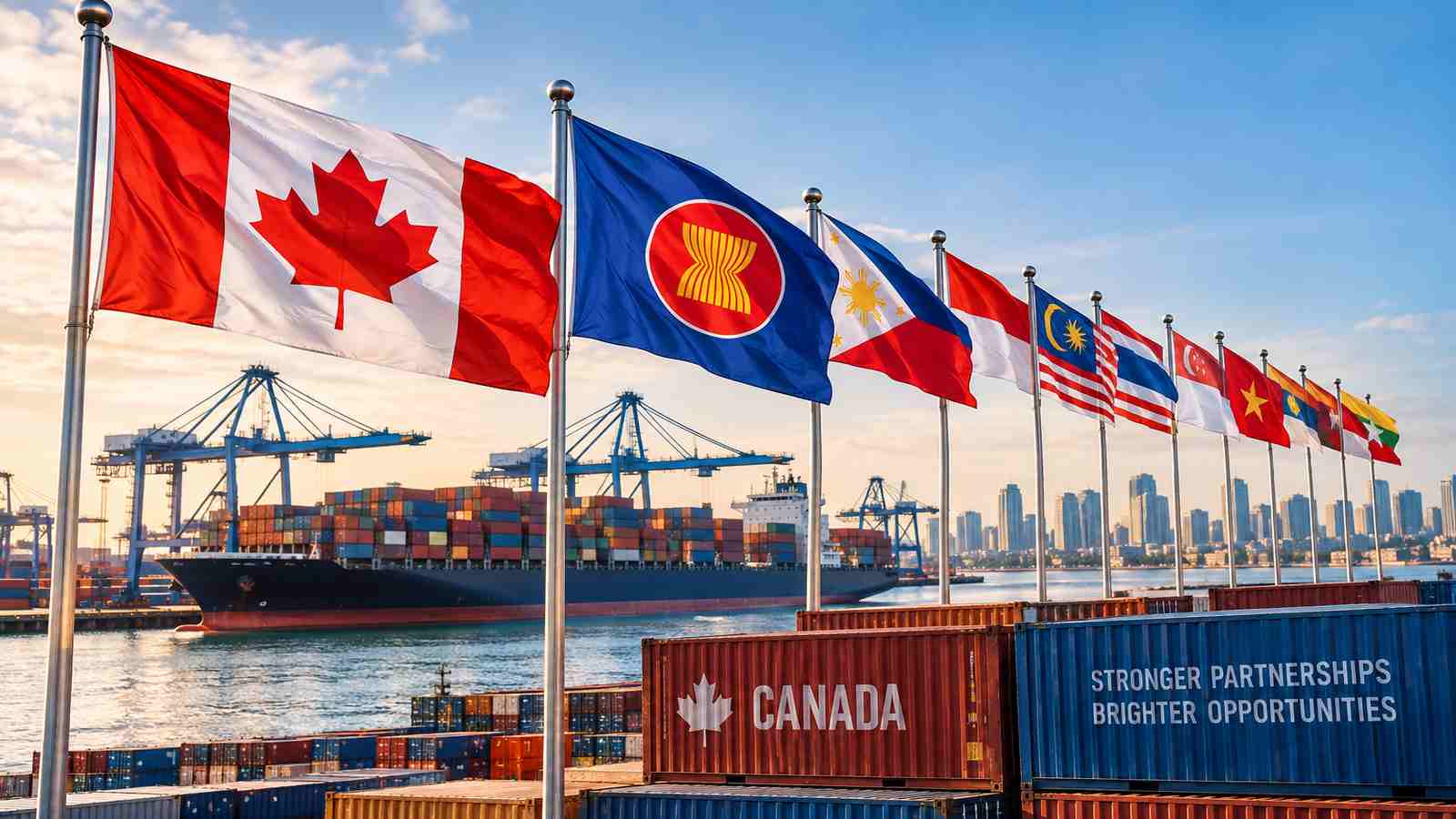
Canada Targets Greater Access to Southeast Asian Markets
The trade negotiations form part of Canada's broader effort to expand commercial relationships beyond its traditional markets.
Global Affairs Canada says Southeast Asia is among the world's fastest-growing economic regions and represents opportunities across sectors including critical raw minerals, energy transition, clean technology, agriculture, financial services, aerospace and infrastructure.
Canada's government has identified trade diversification as an important part of its Indo-Pacific engagement.
Minister Sidhu said Canada wants to build momentum toward agreements with India, ASEAN and the Philippines while strengthening trade relationships and attracting new investment to Canada.
Canada and ASEAN Are Negotiating a Separate FTA
Canada and ASEAN have been negotiating a possible free trade agreement since 2021.
The proposed ASEAN-Canada Free Trade Agreement is intended to strengthen commercial relations and create new market opportunities for Canadian goods and services.
According to Global Affairs Canada, a completed agreement could also establish a more transparent and predictable environment for trade and investment.
The negotiations cover Canada and the ten ASEAN member states, making the potential agreement significantly broader than Canada's separate bilateral discussions with the Philippines.
Philippines Agreement Moves Alongside ASEAN Talks
Canada is also negotiating a bilateral free trade agreement directly with the Philippines.
Global Affairs Canada currently lists the Canada-Philippines FTA as “In negotiations.”
Canada and the Philippines launched negotiations toward a bilateral FTA in October 2025. The Canadian government says the agreement is intended to reduce trade and investment barriers, improve predictability for businesses and create new market-access opportunities.
The bilateral negotiations could also build on the potential outcomes of a future Canada-ASEAN agreement.
Trade With the Philippines Is Growing
The Philippines has become an increasingly important market for Canadian exporters in Southeast Asia.
The Government of Canada says the Philippines was Canada's sixth-largest merchandise export market in ASEAN in 2025.
Two-way merchandise trade between Canada and the Philippines reached C$3.4 billion in 2025, compared with C$3.2 billion in 2024.
Canadian merchandise exports to the Philippines totalled C$1.1 billion in 2025, while imports from the Philippines reached C$2.3 billion.
Canada-ASEAN Trade Reached C$52.5 Billion
Trade between Canada and ASEAN is considerably larger.
According to Global Affairs Canada, Canada-ASEAN bilateral merchandise trade reached C$52.5 billion in 2025, up from C$42.4 billion in 2024.
That represented a 23.7% increase over the previous year.
Canadian merchandise imports from ASEAN have also increased substantially since 2020, highlighting the region's growing importance within Canada's international trade network.
Canada Wants to Expand Trade Beyond the United States
The Southeast Asian negotiations are part of Canada's broader trade diversification strategy.
Global Affairs Canada says Canada is looking to double its exports to markets beyond the United States over the next decade.
The government has also set a target of doubling two-way trade with India to C$70 billion annually by 2030.
The broader strategy includes negotiations with India, ASEAN and the Philippines, giving Canada multiple potential avenues for expanding commercial relationships across the Indo-Pacific.
2026 Is the Target for the Trade Negotiations
Canada and its negotiating partners have established objectives to conclude the relevant trade negotiations by the end of 2026.
For the Philippines, the Canadian government has stated its objective of reaching an agreement by the end of the year.
Canada and ASEAN have also been working toward completing their negotiations in 2026.
However, the agreements remain under negotiation and their final terms have not yet been concluded.
What the Agreements Could Mean for Canada
If successfully completed, the agreements could provide Canadian businesses with additional access to Southeast Asian markets.
Potential areas of opportunity include agriculture and agri-food, critical minerals, clean technology, energy, financial services, infrastructure and other sectors where Canada already has commercial interests in the region.
The agreements could also create clearer rules for trade and investment and strengthen supply-chain relationships between Canada and Southeast Asian economies.
For now, the focus remains on negotiations and continued engagement between Canadian and Southeast Asian officials.
The September 21-22 meetings in Manila represent another step in Canada's effort to advance these agreements and expand its commercial presence across the Indo-Pacific region.