
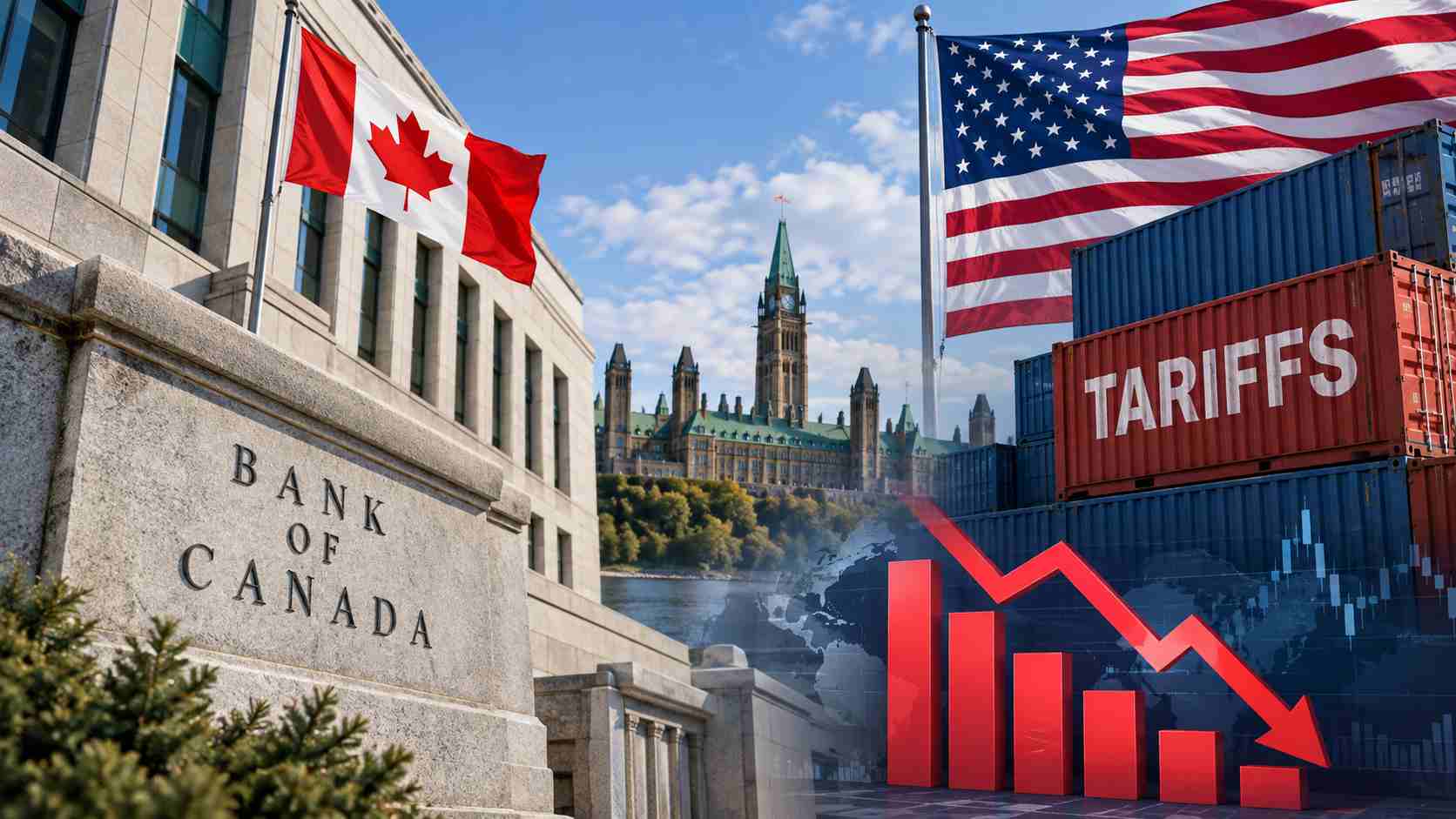
New U.S. Tariffs Add Pressure to Canada's Economy
Macklem said Canada-U.S. trade tensions have re-escalated, creating fresh uncertainty for businesses and households.
Canadian businesses have already spent much of the past year adapting to tariffs, retaliatory measures and changes in the trading relationship.
According to the Bank of Canada, the products affected by the latest U.S. tariffs represent about 5% of Canada's goods exports to the United States.
While the Bank does not expect a large direct effect on the overall economy from those products alone, the uncertainty surrounding U.S. trade policy could have broader consequences.
Q4 Growth Could Fall Below 1%
The Bank of Canada's most significant warning concerns fourth-quarter economic growth.
Macklem said that if the new U.S. tariffs remain in place, growth could be roughly halved in the fourth quarter, bringing it to below 1%.
The estimate reflects both the direct impact of tariffs and the broader uncertainty they create for Canadian businesses.
The Bank said businesses could once again delay investment and hiring decisions as they reassess the changing trade environment.
Businesses Could Delay Investment and Hiring
Canadian companies have already spent considerable time adapting to the changing Canada-U.S. trade relationship.
Macklem said businesses are adjusting supply chains, changing sourcing strategies and looking for opportunities in markets outside the United States.
However, renewed uncertainty can make companies more cautious.
Businesses may delay decisions involving new investments, expansion and hiring while they wait for greater clarity about tariffs and future trade conditions.
The Bank warned that such a reassessment could restrain economic growth and set back some of the progress seen during Canada's recovery.
Canada's Economy Had Started to Recover
Despite the latest risks, Macklem said Canada's economy entered the summer in a stronger position.
Exports, investment and economic growth had picked up, while labour-market conditions had begun to improve.
The Bank also noted that business investment rose at an annualized rate of 8.8% in the second quarter.
Canadian exporters are also looking beyond the United States. More than two-thirds of Canadian exporters surveyed by the Bank said they planned to expand into new markets over the next two years.
That diversification could help businesses reduce their exposure to changes in U.S. trade policy over time.
Inflation Remains Another Concern
Trade uncertainty is creating downside pressure on economic growth, but higher energy prices are moving inflation in the opposite direction.
Macklem said inflation has remained around 3% in recent months, largely because of higher fuel prices.
The Bank expects inflation to edge higher in the coming months if oil prices remain near $100 per barrel.
The situation creates a difficult environment for monetary policy because weaker economic growth can reduce inflation pressure, while higher energy costs can push inflation upward.
Middle East Conflict Adds Energy Pressure
The Bank of Canada's economic assessment also highlighted the continuing conflict in the Middle East.
Shipping routes remain disrupted and damage to global refining capacity has increased fuel costs.
Macklem said that under normal circumstances, a 10% increase in oil prices adds about 0.2 percentage points to consumer price inflation.
However, the current situation is also being affected by higher refining costs, meaning gasoline and diesel prices have increased more than would normally be expected from crude oil prices alone.
What This Means for Monetary Policy
The combination of weaker growth and higher inflation creates a complicated environment for the Bank of Canada.
Macklem said the Bank has been looking through the direct impact of higher oil prices on inflation because it has so far seen little evidence that the higher costs are spreading to other goods and services.
However, he said the Bank is watching closely. With the conflict continuing and shipments from the Middle East still curtailed, the risk that inflation broadens and becomes more persistent has increased.
Canadian counter-tariffs could also add costs for some businesses and eventually feed into consumer prices. The Bank expects their effect on inflation to be modest because they primarily target non-consumer goods that can be replaced with Canadian substitutes.
Canada-U.S. Trade Relationship Remains Crucial
The United States remains Canada's largest trading partner, making changes in the bilateral trade relationship particularly important for Canadian businesses.
Macklem said the uncertainty surrounding trade policy could continue to affect investment and hiring decisions.
At the same time, many Canadian exporters say they plan to broaden their customer base and expand into new markets, including in Europe and the Asia-Pacific region.
Diversification is not easy, but the Bank said these efforts can help businesses build resilience by broadening their options.
What Happens Next?
Macklem said the effects of tariffs, trade uncertainty, oil prices and inflation will depend on how events unfold and how Canadians adapt.
The Bank is watching for signs that higher energy costs are spreading beyond fuel prices into other goods and services.
Developments in Canada-U.S. trade relations and global energy markets will remain important to the outlook for growth and inflation.
Bottom Line
The Bank of Canada has warned that new U.S. tariffs could cut Canada's fourth-quarter economic growth to below 1% if the measures remain in place.
The potential slowdown comes through both the direct impact of tariffs and the uncertainty they create for investment and hiring.
At the same time, higher oil prices are keeping inflation elevated, leaving the Bank of Canada to manage competing risks to growth and price stability.