
Key Takeaways
- Barrie Police are running two 60-day Drone as First Responder trials, with the drone docked on the City Hall Rotunda roof
- The drone launches within 25 seconds, flies up to 40 minutes within a 3.7 km radius, and has no facial recognition or plate readers
- A November 18 test flight helped officers quickly locate a person in crisis, who was ultimately okay
The First Responder Now Has Propellers
When a 911 call comes in across Barrie, the first responder may soon have propellers.
The Barrie Police Service has launched a Drone as First Responder trial — two consecutive 60-day trials in which a remotely piloted drone flies to calls for service and streams real-time aerial information to officers before they arrive.
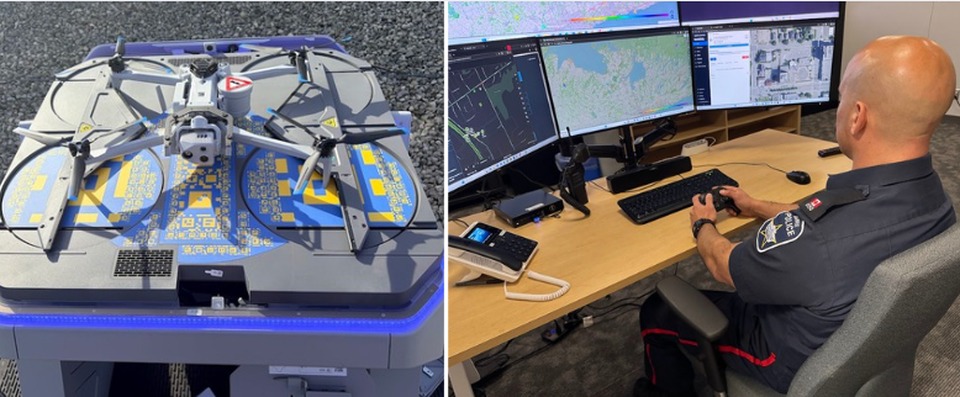
The drone lives in a dock on the roof of the Barrie City Hall Rotunda and is flown by a certified operator stationed at police headquarters. It can be airborne within 25 seconds, stay up for up to 40 minutes, and cover a 3.7-kilometre radius — never flying lower than 100 feet, under a trial approved by Transport Canada.
Privacy limits are built into the design: the drone has no facial recognition and no licence plate readers. While it can record, it is not always recording — the operator decides. A public usage dashboard is promised on the police website.
The trial has already had its moment. On November 18, during a test flight, a person-in-crisis call came in. The drone located and monitored the individual and relayed information to responding officers, who reached the person quickly. The individual was ultimately okay.
"This is about getting important information to our officers sooner," said Chief Rich Johnston. "The drone doesn't replace the work our officers do. It gives them another tool to support that work."
"This is not about general monitoring or surveillance of our community," Johnston added. "It is about using technology for a specific public safety purpose when it can make a difference."
The Twikup Take
Every police service in Canada is about to face the same question Barrie just answered in public: a drone that arrives in 25 seconds can tell officers whether a call is a false alarm, a fight, or a person in crisis — before anyone walks in blind. What makes the Barrie trial worth watching is not the drone; it is the guardrails published alongside it — altitude floors, no facial recognition, a public dashboard. If the model spreads, it will spread on the strength of those limits, not the flight time.
Image: Barrie Police Service. (L) The Drone as First Responder (DFR) is pictured in its dock on the roof of the Rotunda at City Hall in Barrie, Ont. (R) Police Const. Daniel Steele is pictured at the DFR controls at Barrie Police Headquarters.