
What happened
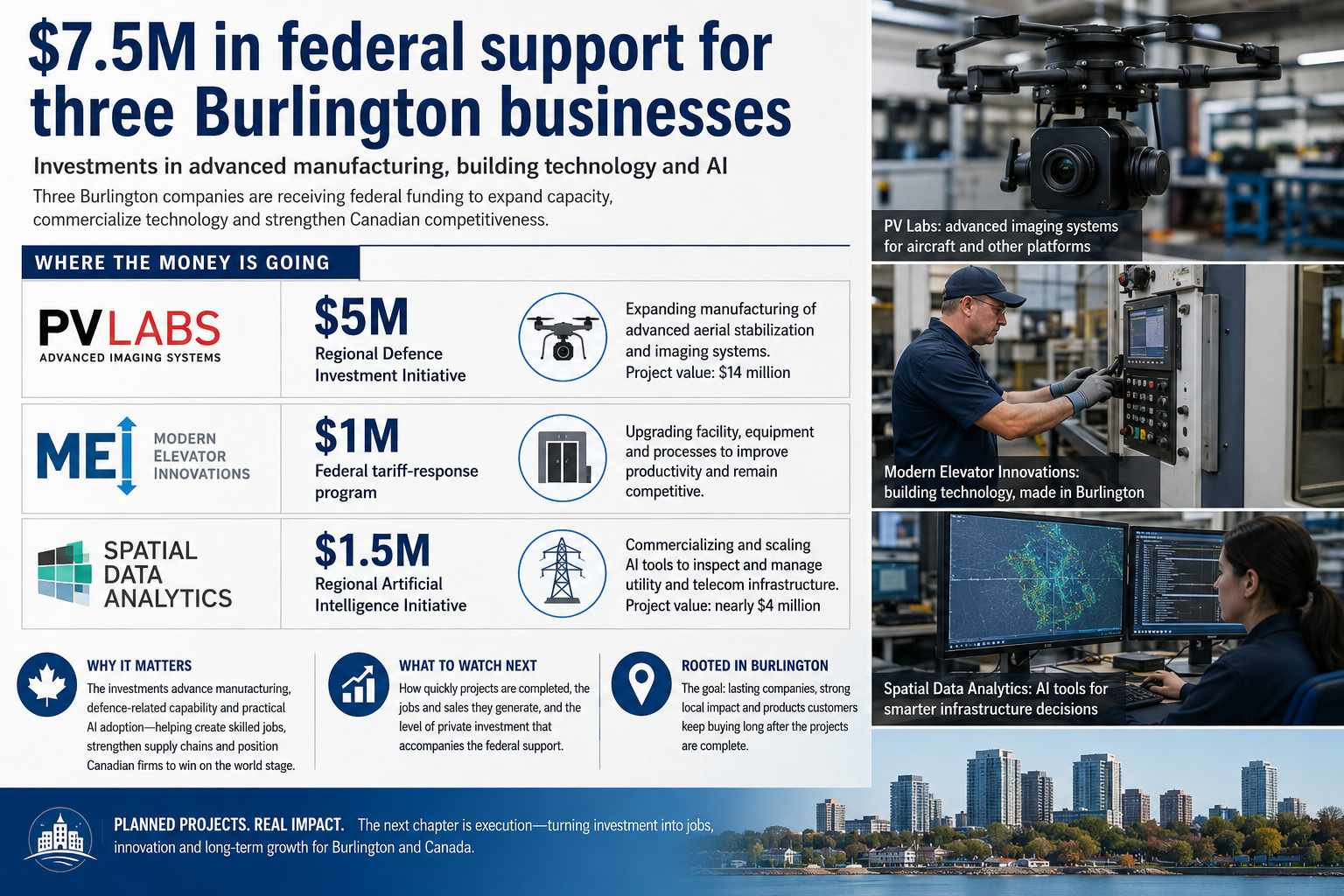
Three Burlington businesses are receiving a combined $7.5 million in federal support for expansion projects in advanced manufacturing, building technology and artificial intelligence.
FedDev Ontario announced the investment on July 27, identifying PV Labs, Modern Elevator Innovations and Spatial Data Analytics as the recipients. Although the companies operate in different markets, each project is intended to help a Canadian business add capacity, commercialize technology or improve production.
Where the money is going
PV Labs is receiving $5 million through the Regional Defence Investment Initiative. The company is undertaking a $14 million project to expand manufacturing of advanced aerial stabilization and imaging systems. Those systems are used to keep cameras and sensors steady on aircraft and other moving platforms, where accurate images can depend on precise control.
Modern Elevator Innovations will receive $1 million through a federal tariff-response program. The Burlington manufacturer plans to upgrade its facility, equipment and processes. The support is aimed at helping the company improve productivity and remain competitive while manufacturers face changing trade conditions and input costs.
Spatial Data Analytics is receiving $1.5 million through the Regional Artificial Intelligence Initiative. Its project, valued at nearly $4 million, will commercialize and scale AI-based tools used to inspect and manage utility and telecommunications infrastructure. That work can help operators review physical networks more efficiently and identify maintenance needs.
Why it matters
The announcement connects three economic priorities that are frequently discussed separately: domestic manufacturing, defence-related capability and practical AI adoption.
For Burlington, the projects reinforce the city’s role as more than a commuter-market economy. Specialized manufacturers and software companies can create technical jobs, support local suppliers and sell products beyond the region. At the national level, expanding production in strategic technologies can reduce reliance on external suppliers and give Canadian firms a better chance to compete for larger contracts.
The AI project is also a useful example of commercialization rather than experimentation. Its value will depend on whether utilities and telecom companies adopt the inspection tools at scale and whether those tools produce faster, safer or less costly infrastructure decisions.
What to watch next
Public funding announcements describe planned projects, not guaranteed results. The next questions are how quickly the companies complete their expansions, whether the projects lead to durable jobs and sales, and how much private investment accompanies the federal contributions.
It will also be important to see whether the new capacity remains rooted in Burlington. Success would mean more than upgraded equipment: it would include stronger Canadian supply chains, export growth and products that customers continue buying after the supported projects are complete.