
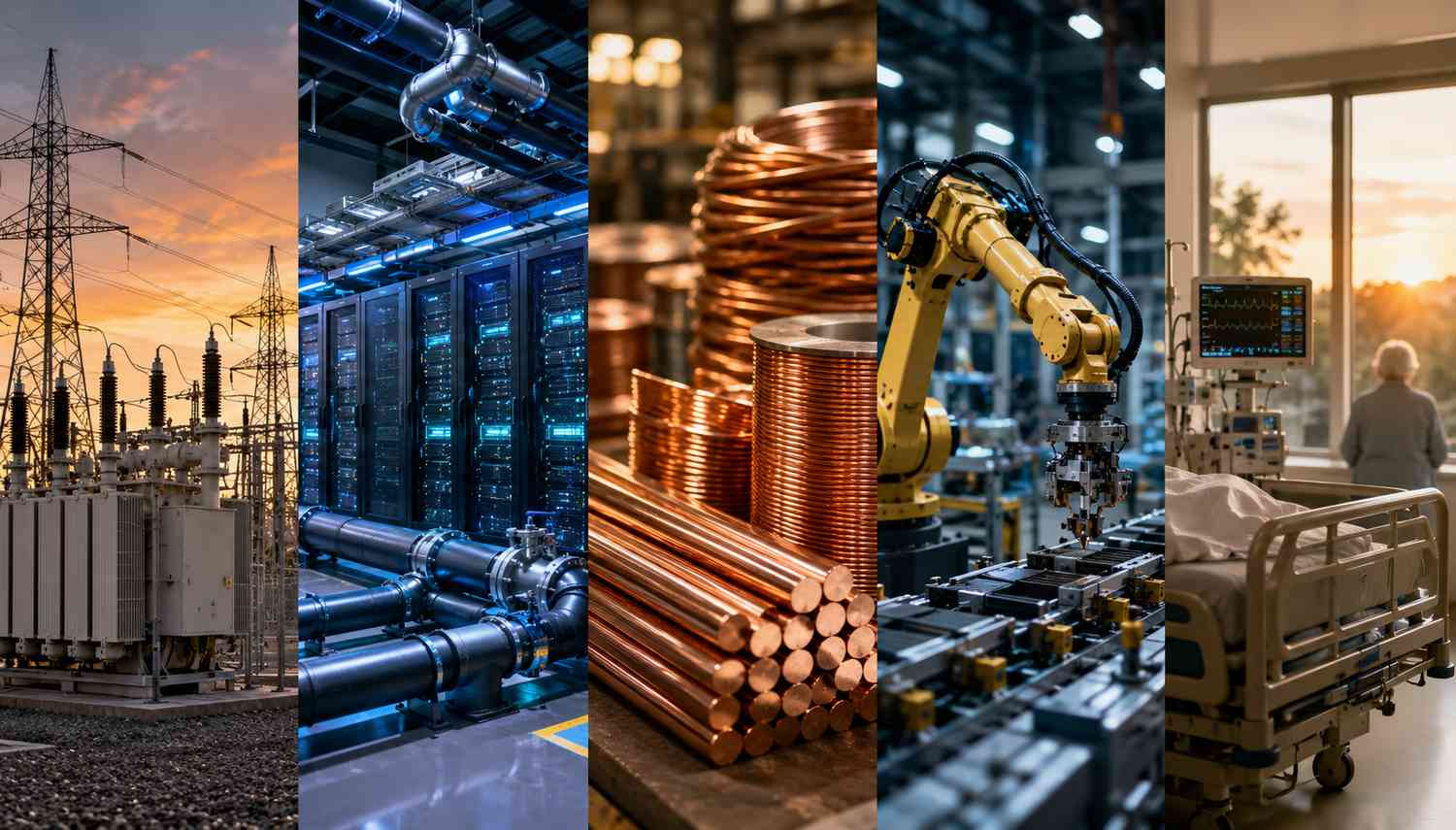
Key Takeaways
- AI expansion depends on physical systems including power generation, grids, transformers, cooling equipment and materials.
- Data-centre electricity demand could rise sharply by 2030, making infrastructure capacity a key constraint on AI growth.
- Ageing populations and worker shortages could increase demand for healthcare infrastructure and industrial automation.
Start With Something That Doesn't Look Physical at All
Ask ChatGPT a question and an answer appears within seconds.
It feels almost weightless.
But somewhere behind that response are processors running inside buildings filled with servers, networking equipment, electrical systems and cooling infrastructure.
Artificial intelligence may live on a screen, but the infrastructure supporting it most certainly does not.
The International Energy Agency now estimates that electricity consumption from data centres could rise from about 485 terawatt-hours in 2025 to around 950 TWh by 2030 in its central projection. AI-focused data centres are expected to grow considerably faster than the overall data-centre market.
Think about that for a moment.
Before the world can have dramatically more AI, it may need dramatically more electricity.
And once you follow the electricity, the story begins moving away from the companies everyone talks about.
The AI Boom Could Run Into a Transformer
Here's one of the strangest possibilities of the next decade.
A company can raise billions of dollars, buy advanced processors and secure land for a giant data centre.
And then it still needs something that looks like it belongs in an old industrial photograph:
an electrical transformer.
Transformers change voltage so electricity can move through the grid and ultimately reach homes, factories, offices and data centres.
They're not new.
They're not fashionable.
And they're suddenly very important.
The U.S. Department of Energy says distribution-transformer demand has risen sharply while supply-chain constraints have produced unusually long waiting periods. DOE reported that lead times that were roughly three to six months in 2019 had stretched to roughly one to two years or longer by 2024 for some distribution transformers. Large transformers can take even longer.
That's an extraordinary collision between two eras of technology.
At one end of the system: some of the most sophisticated computing machines humans have ever built.
At the other: a shortage of giant pieces of electrical equipment.
The future may be digital.
Its bottlenecks can still weigh several tons.
And One Transformer Isn't Enough
Getting electricity into a data centre requires far more than one piece of equipment.
Power needs to be generated somewhere. Transmission lines have to move it. Substations have to manage it. Transformers change its voltage. Switchgear controls and protects the system. Cooling equipment then has to remove the enormous amount of heat generated inside the building.
Suddenly, the AI revolution starts looking suspiciously like an infrastructure boom.
The IEA projects electricity generation serving data centres could increase from about 460 TWh in 2024 to more than 1,000 TWh by 2030 in its base case. Renewables are expected to provide a large portion of the additional supply, while natural gas also plays an important role and nuclear becomes increasingly significant toward the end of the decade and beyond.
That doesn't mean every utility, nuclear company or equipment manufacturer suddenly becomes a winner.
It means something more interesting:
The economic footprint of AI could become much larger than the AI industry itself.
The Next Hot Technology Could Literally Be Cooling
There's another problem hiding inside every powerful computer.
Heat.
Pack increasingly powerful processors into a data centre and they generate enormous amounts of it. Removing that heat isn't optional. If equipment can't operate safely and reliably, all that computing power becomes useless.
The IEA estimates cooling and other data-centre infrastructure account for a meaningful part of the expected increase in electricity consumption this decade.
That brings some remarkably unglamorous technologies into the AI conversation: liquid-cooling systems, heat exchangers, pumps, chillers, HVAC equipment and increasingly sophisticated thermal-management systems.
Nobody is going to stand outside a store overnight waiting for the newest industrial heat exchanger.
But that is exactly the point.
The products we notice aren't necessarily the products an economy desperately needs.
Then the Digital Economy Hits the Periodic Table
Keep following the chain.
More data centres need more electricity infrastructure. More electricity infrastructure requires more equipment. And equipment requires physical materials.
Copper is an obvious example.
According to the U.S. Geological Survey, electrical and electronic products accounted for about 23% of U.S. copper and copper-alloy product use in 2025, while construction accounted for another 42%.
Copper already runs through buildings, electrical equipment, machinery and power systems. A world simultaneously expanding electricity networks, data centres, factories and automation therefore has to think about materials as well as software.
That leads to one of the most interesting contradictions of the coming decade.
We could build an economy increasingly powered by artificial intelligence, yet some of its most important constraints could involve metals humans discovered thousands of years ago.
Of course, that doesn't mean copper prices can only move upward. Higher prices encourage new mining, recycling, efficiency and substitution.
The bigger lesson is simpler:
Even the cloud eventually touches the ground.
Robots Have a Hidden Economy Too
Now imagine another technology people expect to become much larger over the next decade: robotics.
The image everyone sees is a humanoid machine walking through a factory, warehouse or home.
But strip away the science-fiction appearance and a robot becomes a collection of very physical things.
It needs motors to move. Actuators to control movement. Sensors to understand its environment. Cameras and processors to interpret information. Bearings, gears, batteries, controllers and power electronics to turn intelligence into action.
So if robotics eventually scales from impressive demonstrations to large numbers of machines doing useful work, the opportunity doesn't stop with whoever puts a logo on the robot.
It spreads through the industrial ecosystem underneath it.
That is a pattern worth remembering.
When a new technology becomes enormous, its suppliers can become enormous too.
Now Add a Trend Technology Can't Stop: Ageing
There's another economic force developing at the same time, and it has nothing to do with AI hype.
People are getting older.
Statistics Canada estimated that people aged 65 and older represented 19.5% of Canada's population in 2025. Under every projection scenario released by the agency, that share rises over the long term.
But the 85-and-older group is particularly revealing.
Canada had roughly 952,000 people aged 85 or older in 2025. Statistics Canada expects that population to increase rapidly, especially between 2031 and 2050 as large baby-boom cohorts move into those ages.
Statistics Canada is careful to describe these as projections rather than predictions, because migration, fertility, mortality and policy can change.
Still, the direction raises an economic question that receives much less attention than the latest AI model:
Who takes care of millions more older people?
That could increase pressure on healthcare systems, home care, medical equipment, accessibility technology and assisted-living infrastructure.
And if ageing contributes to worker shortages in parts of the economy, it creates another connection back to automation.
The robot story and the demographic story may eventually become the same story.
This Is Where the Pieces Suddenly Fit Together
Look at each industry separately and the argument feels scattered.
Put them into chains and it becomes much clearer.
AI growth creates demand for more data centres. Data centres require electricity. Electricity requires generation, grids, substations and transformers. Those systems require equipment and materials. Powerful computers produce heat, creating demand for cooling infrastructure.
Meanwhile, worker shortages can encourage automation. Automation creates demand for robots. Robots require motors, sensors, chips, batteries and industrial equipment.
Then ageing increases demand for healthcare at the same time that many economies may need technologies capable of helping a smaller or slower-growing workforce do more.
This is why trying to guess the one industry that will dominate the next decade may be the wrong exercise.
The more useful question could be:
What industries become unavoidable if the trends we can already see continue?
The Biggest Opportunity Might Be Something You Never Use
History has a habit of making supporting infrastructure look obvious only after it has been built.
People remember cars. They think less about highways, fuel stations and the enormous industrial systems constructed around them.
People remember smartphones. They rarely think about cell towers, semiconductor fabrication equipment, undersea cables and data centres.
And twenty years from now, people may remember the AI models and robots that changed everyday life.
But the economic story underneath them could include millions of pieces of equipment almost nobody outside those industries recognizes.
Transformers.
Switchgear.
Cooling systems.
Industrial motors.
Transmission equipment.
Copper wiring.
Power-generation infrastructure.
Those aren't particularly exciting words.
But economies don't care whether something sounds exciting.
They care whether they can function without it.
TwikUp Insight
There's a temptation whenever a technological revolution begins to search for its biggest star.
What's the next Nvidia?
What's the next breakthrough AI company?
Who's going to win robotics?
Those questions can be interesting, but they may cause us to stare at the top of the pyramid while ignoring everything holding it up.
Perhaps the defining economic story of the next decade won't simply be that artificial intelligence became extraordinarily powerful.
It could be that AI forced countries to rebuild electrical infrastructure, expand power generation, manufacture equipment they didn't have enough of, rethink cooling, secure materials and automate industries far beyond technology.
And ageing populations could push some of those changes even faster.
So maybe the next boom won't arrive with a dramatic product launch.
Maybe it arrives on the back of a truck carrying a transformer to a new substation.
Maybe it's inside the cooling system of a data centre nobody ever visits.
Maybe it's buried beneath the ground in an electrical cable.
That would be strangely appropriate.
The technology everybody sees could start the next economic boom.
But the industries nobody sees may have to build it.
This article discusses economic and industry trends for informational and educational purposes. It is not investment advice. Growth in an industry does not necessarily mean that individual companies or investments within that industry will perform well.