
Key Takeaways
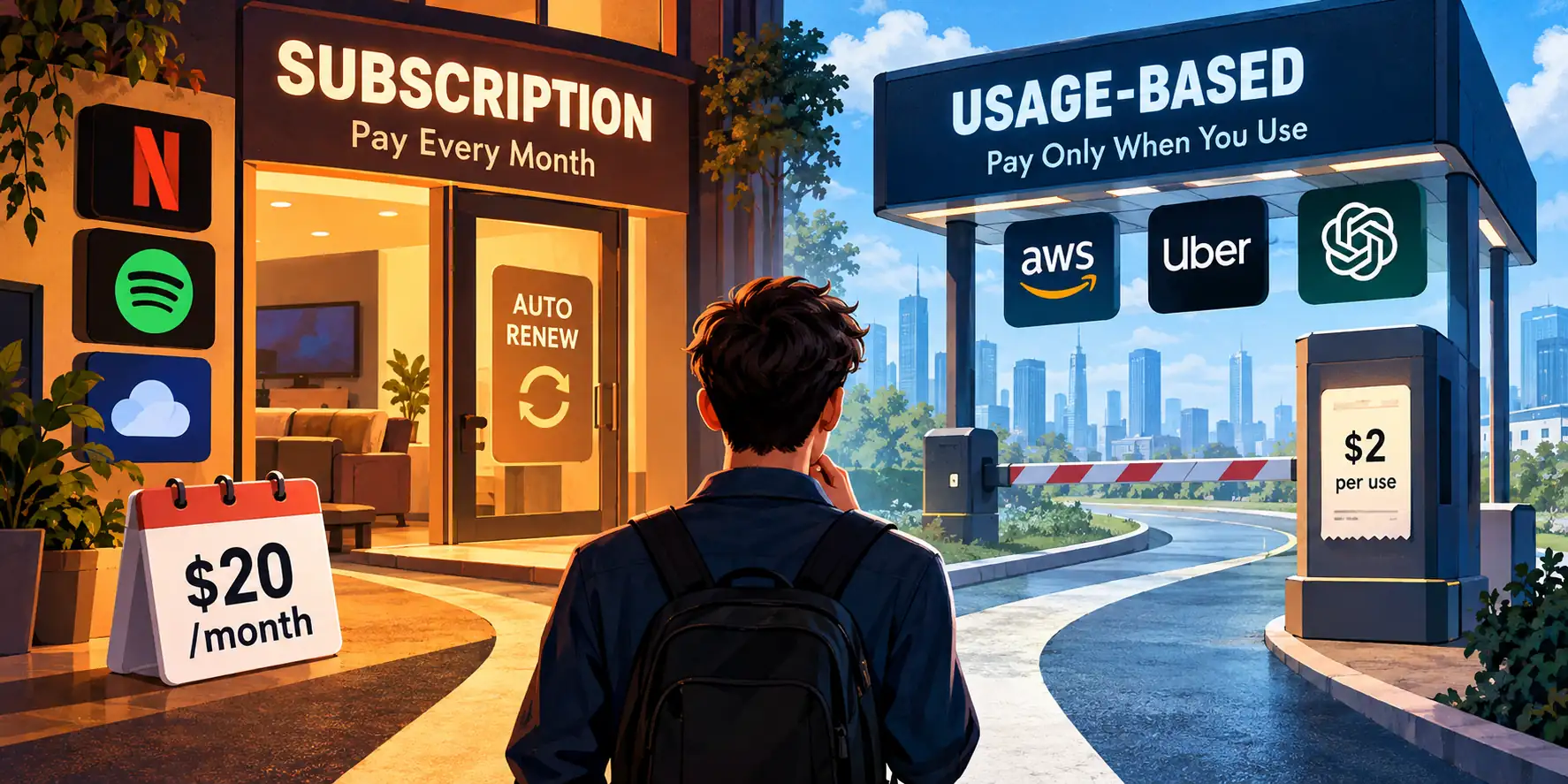
- Subscriptions create predictable revenue but require companies to keep proving ongoing value to prevent cancellations.
- Usage-based pricing can lower the entry barrier and grow with customer activity, but revenue falls when usage drops.
- Pricing must account for service costs: unlimited subscriptions can lose money when heavy usage is expensive to deliver.
Imagine paying $20 every month for a gym membership you haven't used in six months.
That's $120 gone. Zero workouts. Not even a visit to the treadmill.
Now imagine another gym charging you $5 every time you walk through the door. Don't go? Don't pay.
As a customer, the second option sounds like a fantastic deal. But here's the interesting question: Which gym owner would actually make more money?
The answer reveals one of the biggest decisions startups face: whether to charge customers a fixed subscription or collect money every time they use a service.
And surprisingly, the business collecting more money isn't always the one making more profit.
Why Businesses Love Getting Paid Even When You Do Nothing
Think about Netflix. Whether you watch 30 movies this month or forget the app exists, your subscription still renews unless you cancel.
For a business, that predictability is valuable.
Imagine a startup selling software for $20 per month to 10,000 customers.
That's $200,000 in monthly revenue, or $2.4 million annually, assuming all customers keep paying.
The company can use that predictable income to plan hiring, develop products and estimate future cash flow.
But there's a catch.
Customers eventually notice when they're paying for something they barely use. And when enough of them cancel, that dependable monthly revenue starts disappearing.
A subscription business isn't just trying to attract customers. It must continuously convince them that another monthly payment is worth it.
The Other Strategy: Don't Use It, Don't Pay
Now consider Amazon Web Services (AWS), which offers pay-as-you-go pricing for many of its cloud services.
Instead of requiring every customer to pay the same monthly fee, AWS generally charges according to the computing resources and services consumed.
A small business might spend relatively little. A rapidly growing company could spend thousands or much more.
The advantage? Customers can start small, while the provider earns more as their usage increases.
But there's a hidden weakness.
Imagine a startup whose customers collectively spend $100,000 in January. In February, those customers cut their usage in half.
Revenue could drop dramatically, even though the startup hasn't lost a single customer.
That's the trade-off: subscriptions make revenue easier to predict, while usage-based pricing ties revenue more closely to customer activity.
Two Startups, 1,000 Customers — Who Makes More Money?
Imagine two fictional startups offering exactly the same AI writing service.
Startup A charges $20 per month, regardless of how many documents a customer generates.
Startup B charges $2 for every document generated.
Both attract 1,000 paying customers.
At five documents per customer, Startup A collects $20,000 monthly. Startup B collects just $10,000.
At ten documents, both collect $20,000.
But at twenty documents, something interesting happens.
Startup A still collects $20,000. Startup B now collects $40,000.
Same customers. Same product. Twice the revenue.
The subscription startup wins when customers use the service less. The usage-based startup wins when they use it more.
But revenue alone doesn't tell us which business is actually winning.
The Twist: More Revenue Doesn't Always Mean More Profit
Suppose generating each AI document costs the startup $0.50.
If every customer generates twenty documents, both startups must produce 20,000 documents, costing $10,000.
Startup A collects $20,000 and has $10,000 remaining after document-generation costs.
Startup B collects $40,000 and has $30,000 remaining.
Now reverse the situation.
Suppose every customer generates only two documents.
Startup A still collects $20,000 but spends just $1,000 generating documents, leaving $19,000.
Startup B collects only $4,000 and spends the same $1,000, leaving $3,000.
Suddenly, the subscription startup looks much more attractive.
These figures exclude salaries, marketing, infrastructure overhead and other expenses. They represent simplified contribution margins, not actual company profits.
The lesson? A startup shouldn't celebrate higher revenue without understanding what it costs to deliver the service.
The $20 Customer Who Could Cost a Startup $1,000
Here's where things get dangerous.
Imagine an AI startup advertising unlimited document generation for $20 per month.
Most customers generate a few documents. But one particularly enthusiastic customer generates 2,000.
At an assumed cost of $0.50 per document, serving that customer costs $1,000.
The startup collects $20.
That's a $980 loss on one customer before other expenses.
And the customer hasn't done anything wrong. They're simply using the unlimited service they were promised.
Of course, not every subscription business faces this problem. Gyms, streaming platforms and software companies have very different operating costs.
But when every additional action consumes expensive computing resources, unlimited access can become a financial headache.
That's why businesses introduce usage limits, credits, pricing tiers and additional charges.
Sometimes, the customers who love your product most can also be the most expensive to serve.
What If Startups Charged Both Ways?
Some businesses have found a middle ground.
Imagine a startup charging $15 per month, including 100 AI requests, with additional requests billed separately.
The monthly fee creates a predictable revenue base. Extra usage generates additional income from customers who need more.
For customers, the included allowance provides some predictability without necessarily requiring them to buy a much more expensive plan.
But hybrid pricing creates its own challenge: complexity.
A customer who signs up expecting a $15 bill might be unpleasantly surprised when heavy usage pushes it much higher.
A pricing model can look brilliant on a spreadsheet and still fail if customers don't understand what they're paying for.
TwikUp's Perspective: The Best Business Isn't Always the One Charging More
Subscriptions work well when customers value regular access and prefer predictable bills.
Usage-based pricing can be attractive when customer activity varies significantly and delivering additional service creates measurable costs.
Hybrid pricing can combine the advantages of both, but it isn't automatically the best choice.
For startup founders, the real challenge goes beyond choosing between $20 per month and $2 per transaction. They must understand customer acquisition costs, usage patterns, operating expenses and how long customers continue paying.
And here's the interesting part: the same pricing model can be excellent for one customer and terrible for another.
A person generating fifty AI documents every month might save money with a $20 unlimited subscription.
Someone generating just two documents might be better off paying $4.
The company wants predictable revenue. The customer wants good value. Those goals don't always align.
So the next time you see a subscription offer, don't immediately ask whether the monthly price looks affordable.
Ask yourself something more important:
Am I paying for something I actually use, or am I paying every month just in case I might need it?
Because sometimes the smartest business model is the one that earns money while you do absolutely nothing.
And sometimes that's exactly why customers should think twice.
Sources
- Amazon Web Services — Official pricing principles
- Netflix — Official subscription plans and billing
- Stripe — Usage-based pricing advantages and disadvantages
- Stripe Documentation — Subscription, metered and hybrid pricing models
Editorial note: All startup scenarios, customer counts, prices and financial calculations are illustrative examples, not reported financial results from actual companies.