
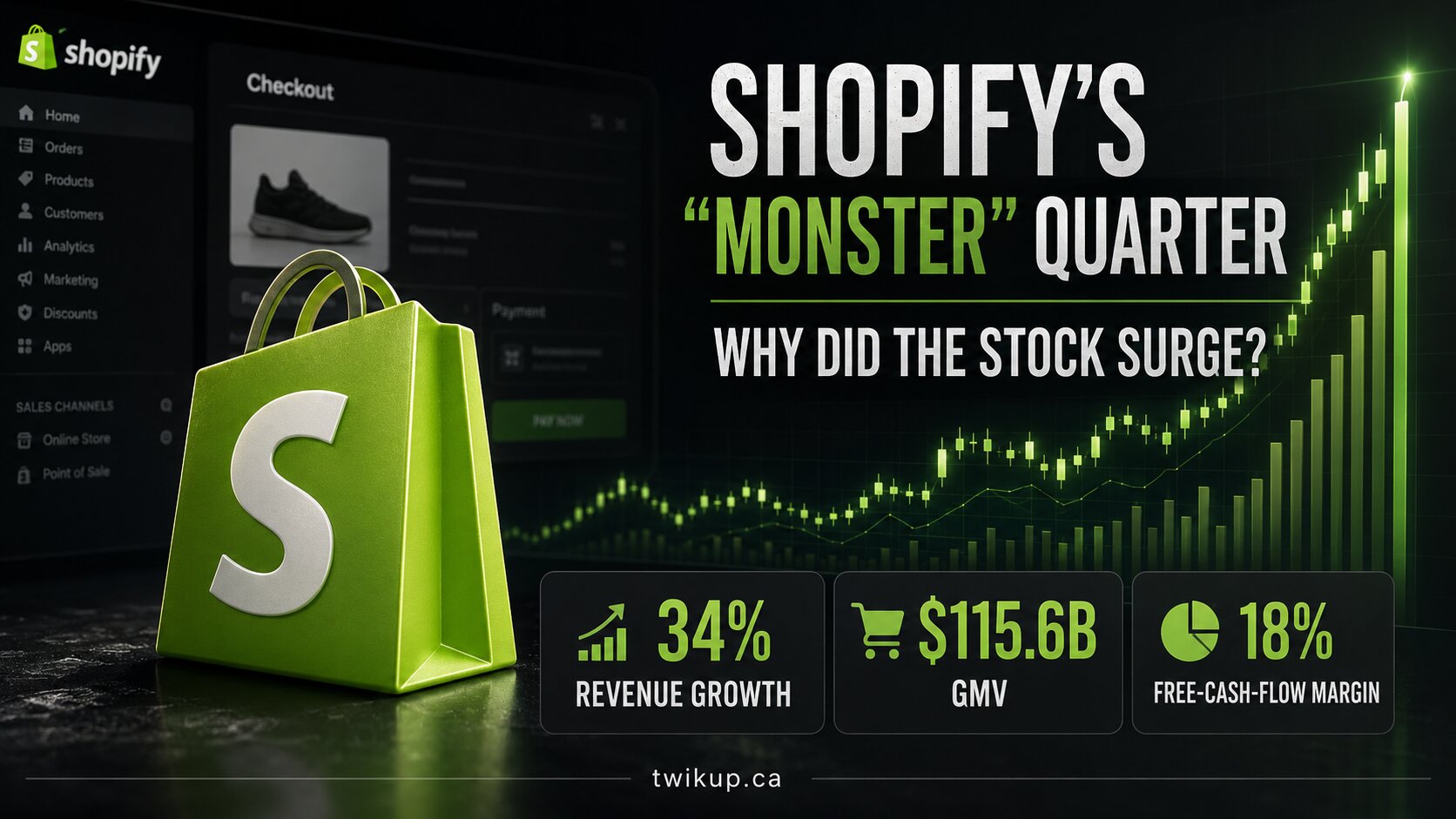
Shopify didn’t merely beat expectations in the second quarter. It delivered the combination investors had been waiting for: 34% revenue growth, 32% growth in commerce volume and an 18% free-cash-flow margin.
Shopify shares were trading approximately 18% higher Wednesday afternoon following the release. The final daily gain may differ from that intraday figure.
President Harley Finkelstein described the performance as a “monster quarter”—and the numbers gave that description substance.
Shopify generated $3.58 billion in revenue while merchants processed approximately $115.6 billion through its platform. The company also forecast revenue growth in the low-30% range for the next quarter.
Together, the results challenged the idea that Shopify must choose between expanding rapidly and maintaining financial discipline.
Quick Answer
Shopify stock surged after its Q2 2026 earnings because the company delivered strong results across nearly every measure investors were watching.
Revenue climbed 34%, gross merchandise volume increased 32%, gross profit rose approximately 31% and the free-cash-flow margin reached 18%.
The market also received an encouraging forward signal: Shopify expects revenue to grow at a low-30% rate in Q3. That suggests its momentum may continue rather than disappear after one unusually strong quarter.
Key Takeaways
- Shopify generated $3.58 billion in Q2 revenue, up 34% year over year.
- Merchants processed approximately $115.6 billion in GMV, an increase of 32%.
- Gross profit rose approximately 31% to $1.71 billion.
- Merchant solutions revenue increased 37%, considerably faster than subscription revenue.
- Shopify Payments processed approximately $78.1 billion in GMV.
- Monthly recurring revenue increased from $185 million to $221 million.
- Shopify delivered an 18% free-cash-flow margin.
- Management expects Q3 revenue growth in the low-30% range.
- Shopify shares were approximately 18% higher Wednesday afternoon, although the final daily move may differ.
The Question Shopify Had to Answer
Shopify makes money in two principal ways.
First, merchants pay recurring fees to use its commerce platform. Shopify can then earn additional revenue when those merchants accept payments, convert currencies, purchase shipping services, obtain financing or use other commerce tools.
That creates an appealing growth model—but only if merchants keep joining, existing businesses keep selling and Shopify can support the additional activity without allowing expenses to rise just as quickly.
The central question going into Q2 was therefore straightforward:
Could Shopify maintain rapid growth while generating more cash from that growth?
The quarter offered a convincing answer.
Merchants Processed $115.6 Billion Through Shopify
Gross merchandise volume, or GMV, measures the total value of orders facilitated through Shopify’s platform. It is calculated after refunds and includes shipping, handling, duties and applicable value-added taxes.
Shopify’s Q2 GMV reached approximately $115.6 billion, compared with $87.8 billion one year earlier. That represents an increase of roughly $27.7 billion, or 32%.
Put differently, merchants processed an average of more than $1.2 billion in sales through Shopify every day during the quarter.
GMV is not the same as Shopify’s revenue. Most of the $115.6 billion belongs to the merchants selling products and services.
The figure nevertheless matters because much of Shopify’s merchant solutions business moves with the amount its merchants sell. Greater commerce volume gives Shopify more opportunities to generate revenue from payment processing, currency conversion, shipping, lending and other services.
Revenue Growth Reached 34%
Shopify generated $3.58 billion in Q2 revenue, up from $2.68 billion in the comparable quarter.
The company produced growth from both of its principal revenue streams:
| Revenue stream | Q2 2026 | Q2 2025 | Growth |
|---|---|---|---|
| Subscription solutions | $802 million | $656 million | 22% |
| Merchant solutions | $2.78 billion | $2.02 billion | 37% |
| Total revenue | $3.58 billion | $2.68 billion | 34% |
Subscription solutions include platform subscriptions, point-of-sale subscriptions, apps, themes and domain registrations.
Merchant solutions include Shopify Payments, currency-conversion fees, lending products, shipping services and other tools connected more directly to merchant activity.
Merchant solutions generated approximately 78% of Shopify’s quarterly revenue, up from about 76% one year earlier.
Revenue also grew slightly faster than GMV. That suggests stronger platform monetization, although currency movements and changes in Shopify’s revenue mix may have contributed as well.
The larger story is that Shopify increasingly grows not only by adding merchants, but also by participating in more of what those merchants do after joining its platform.
Shopify Payments Expanded Its Role
Shopify Payments penetration reached 68% in Q2, up from 64% one year earlier.
In other words, more than two-thirds of the commerce volume processed through Shopify used its integrated payment system.
Shopify Payments handled approximately $78.1 billion in quarterly GMV, compared with $56.6 billion one year earlier. Based on those rounded figures, Payments volume increased by approximately $21.5 billion, or 38%.
Shopify said the largest contributor to its merchant solutions revenue increase was a $624-million rise in revenue associated with Shopify Payments processing and currency-conversion fees.
The growing adoption of Payments deepens Shopify’s relationship with merchants. Instead of receiving only a recurring software fee, Shopify participates directly in the flow of commerce across its platform.
Payment-processing revenue typically has a lower gross margin than subscription revenue because third parties receive part of the economics. Shopify nevertheless says Payments can support operating margins because the service requires considerably less incremental spending on research, development, sales and marketing than building its original subscription platform.
The 18% Cash-Flow Margin Changed the Story
Fast revenue growth was always likely to attract attention. The more consequential number may have been Shopify’s free-cash-flow margin.
Shopify reported an 18% margin for Q2, exceeding its previous expectation of a margin in the mid-teens.
Free cash flow generally measures the cash generated through operations after capital expenditures. Although no single figure perfectly describes a company’s financial performance, free cash flow can help investors evaluate how much cash the underlying business is producing.
Shopify delivered a 15% free-cash-flow margin in Q1. Raising it to 18% while maintaining 34% revenue growth demonstrated increasing operating leverage.
In simple terms, Shopify did not have to increase its expenses as quickly as its revenue to support substantially more commerce.
That was the combination investors wanted:
Shopify was not generating more cash because growth had slowed. It generated more cash while growth remained unusually strong.
Gross Profit Increased Despite the Shift Toward Payments
Shopify’s gross profit increased approximately 31% to $1.71 billion, up from $1.30 billion one year earlier.
Its calculated gross margin was approximately 48%, modestly below the prior-year level of roughly 49%.
That contraction is understandable because merchant solutions—particularly Shopify Payments—generally carry lower gross margins than subscriptions. Merchant solutions also became a larger percentage of Shopify’s total revenue during the quarter.
The important result was that gross profit dollars still grew by more than 30%.
A business can experience a lower percentage margin while generating substantially more gross profit if its revenue expands quickly enough. Shopify’s Q2 results demonstrated that dynamic.
Recurring Revenue Continued to Grow
Monthly recurring revenue, or MRR, reached $221 million at the end of the quarter, compared with $185 million one year earlier.
The 19% increase was slower than Shopify’s overall revenue growth, but it showed that the company’s recurring subscription foundation continued to expand alongside its transaction-based business.
Shopify attributed the improvement partly to an increasing number of merchants and a greater proportion choosing higher-priced plans, including Shopify Plus.
The company also said GMV growth was broad-based across merchant sizes, sales channels and geographic regions.
That breadth makes the results less likely to have been produced by one unusually large customer, market or sales channel.
The Q3 Forecast Gave Investors a Reason to Look Forward
An earnings report explains what happened during the previous three months. A stock price, however, is influenced more heavily by what investors believe will happen next.
Shopify’s Q3 outlook was therefore central to the market reaction.
For the third quarter of 2026, the company expects:
- Revenue growth in the low-30% range.
- Gross profit growth in the mid-to-high-20% range.
- Operating expenses equal to approximately 33% to 34% of revenue.
- Stock-based compensation of approximately $150 million.
- A free-cash-flow margin in the high teens to low 20s.
The forecast suggests Shopify expects to preserve its growth-and-cash-flow combination for at least another quarter.
It also represents a step forward from Shopify’s earlier Q2 outlook. In May, the company forecast Q2 revenue growth in the high-20% range and a free-cash-flow margin in the mid-teens.
The eventual results—34% revenue growth and an 18% free-cash-flow margin—finished comfortably above those targets.
That performance likely gave investors greater confidence in the new Q3 forecast.
Did Artificial Intelligence Cause Shopify’s Growth?
Shopify clearly wants artificial intelligence to be part of its long-term story.
Finkelstein said AI is expanding what Shopify can make possible for businesses, while the company continues to develop AI-supported commerce tools and infrastructure.
It would nevertheless be premature to attribute the entire quarter’s growth to AI.
Shopify’s regulatory filing provides more concrete explanations: higher GMV, increasing Shopify Payments adoption, more merchants, higher-priced subscription plans and expanding payment-processing activity.
AI is also producing real expenses. Shopify’s research and development costs increased 13% to $445 million. The company said the increase included higher computer hardware and software costs related partly to AI usage. Cloud and infrastructure expenses also increased.
The encouraging signal is not that Shopify’s AI development came without a cost. It is that the company absorbed greater technology spending while still producing an 18% free-cash-flow margin.
For now, AI is best understood as an emerging opportunity layered onto a commerce engine that was already expanding rapidly.
The $1.5-Billion Profit Requires Context
Shopify reported GAAP net income of approximately $1.50 billion, or $1.16 per diluted share, compared with $906 million, or $0.69 per diluted share, one year earlier.
That looks spectacular, but it should not be treated as a clean measure of Shopify’s recurring operating performance.
The quarter included approximately $1.25 billion in net gains from equity and other investments. Those gains can fluctuate sharply with the value of Shopify’s investment holdings and may not repeat.
After adjusting for investment-related gains and certain other items, Shopify reported adjusted net income of $549 million, compared with $455 million in the year-earlier quarter.
Operating income, meanwhile, increased to $488 million from $291 million.
Shopify’s underlying operations therefore improved considerably, but investment gains amplified the $1.5-billion headline profit.
Why Shopify Stock Surged
Shopify’s stock reaction was not caused by one isolated number. Investors received several encouraging signals at the same time:
-
Commerce activity remained strong. GMV increased 32% despite a demanding comparison period.
-
Revenue growth slightly exceeded GMV growth. This suggested improving monetization, although revenue mix and currency movements may also have contributed.
-
Payments adoption increased. Shopify Payments handled 68% of platform GMV.
-
Gross profit expanded. Gross profit dollars grew by approximately 31% even as lower-margin merchant services became more important.
-
Cash generation strengthened. The free-cash-flow margin reached 18%, exceeding Shopify’s previous mid-teens forecast.
-
The outlook remained strong. Management forecast another quarter of low-30% revenue growth and a potentially higher free-cash-flow margin.
Together, the results suggested that Shopify was processing more commerce, earning more from that activity and converting a meaningful portion of its revenue into cash.
What Could Still Go Wrong?
One strong quarter does not eliminate Shopify’s risks.
The company operates in a competitive and rapidly changing commerce market. Consumer spending can weaken, tariffs can increase merchants’ costs and international trade restrictions can disrupt products moving across borders.
Shopify also faces cybersecurity risks, reliance on third-party service providers and the possibility that AI-powered shopping platforms could change how consumers discover and purchase products.
Then there is the stock’s valuation.
A large post-earnings rally can increase expectations as quickly as it increases the share price. Investors may now demand that Shopify continue producing revenue growth near 30% while protecting free cash flow and funding AI development.
If growth slows unexpectedly or margins retreat, a highly valued stock can fall sharply—even if the underlying company remains profitable.
TwikUp Insight
Shopify’s “monster quarter” was not simply a story about merchants selling more products online.
The deeper development is that Shopify is becoming more economically involved in each transaction passing through its platform.
A merchant may begin by purchasing a subscription. As that business grows, Shopify can process its payments, convert currencies, provide financing, support in-person sales and supply other commerce services.
That creates a potentially compounding relationship: merchant growth can become Shopify growth without the company needing to acquire a completely new customer for every additional dollar of revenue.
Q2 2026 demonstrated what that model can look like at scale. Merchants processed approximately $115.6 billion, Shopify generated $3.58 billion in revenue and 18% of that revenue translated into free cash flow.
The quarterly numbers were impressive. The Q3 forecast made them more consequential.
Shopify must now prove that its “monster quarter” was not the peak, but another step in a longer expansion.
Investing disclaimer: This article is provided for informational and educational purposes only. It does not constitute financial or investment advice or a recommendation to buy, sell or hold Shopify shares or any other security. Investors should consider their objectives, financial circumstances and risk tolerance before making investment decisions.