
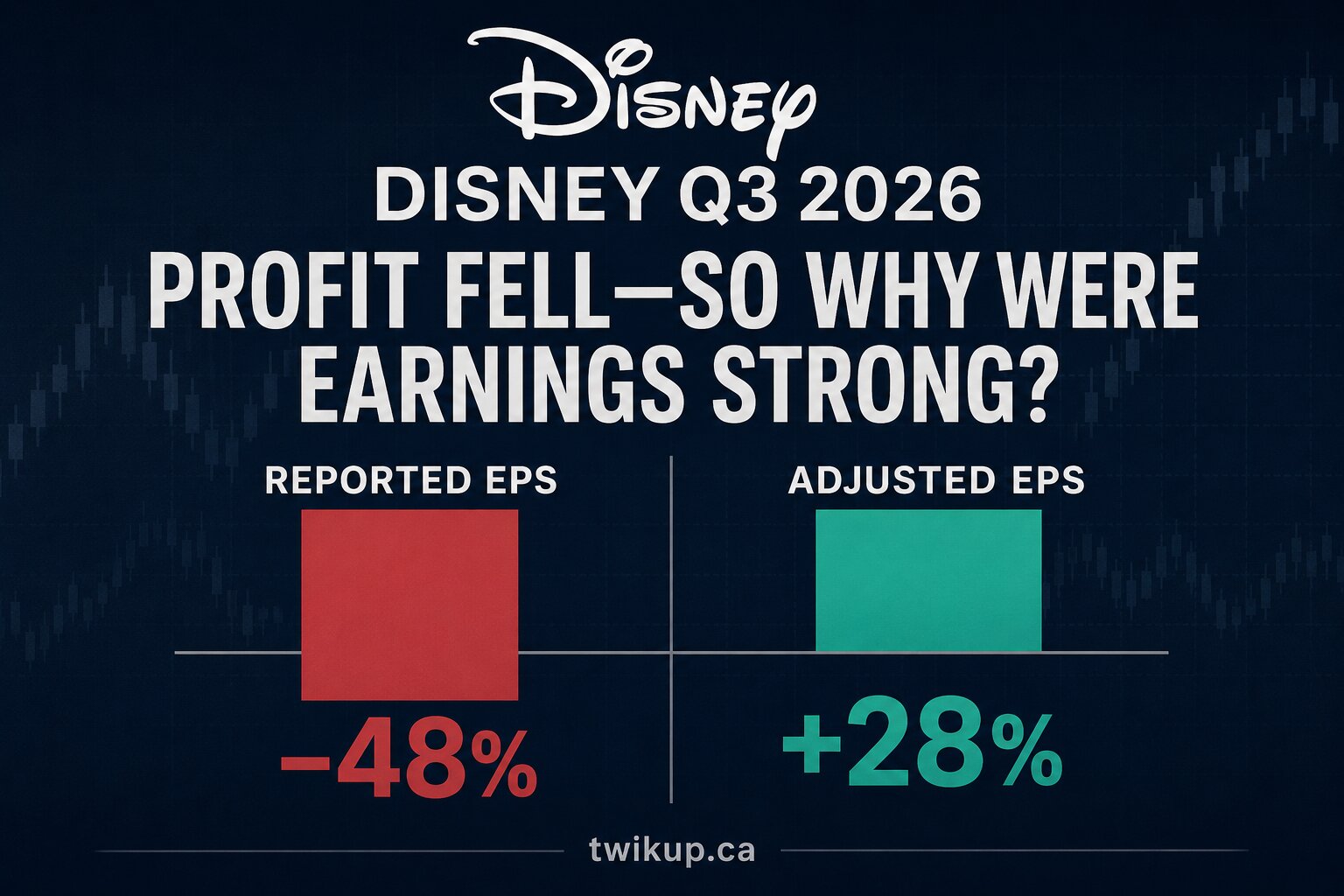
Disney’s latest earnings contain the kind of number that can stop an investor mid-scroll.
The company’s quarterly net income fell from $5.26 billion to $2.64 billion. Reported earnings per share dropped 48%, from $2.92 to $1.51.
At first glance, it looks as though Disney’s business suffered a dramatic decline.
But move one line deeper into the results and a different picture appears. Revenue increased, income before taxes rose, segment operating income climbed, streaming became considerably more profitable and free cash flow jumped 63%.
So, did Disney have a weak quarter or a strong one?
The answer lies in understanding what happened during the previous year—and separating temporary accounting effects from Disney’s underlying business performance.
Quick Answer
Disney’s reported profit fell sharply in its fiscal third quarter of 2026 primarily because the comparable 2025 quarter included a large, non-cash tax benefit connected to Hulu.
Once certain unusual items are excluded, Disney’s adjusted earnings per share increased 28% to $2.06. Revenue rose 7% to $25.25 billion, income before taxes increased 14% to $3.65 billion and total segment operating income climbed 21% to $5.56 billion.
The headline profit decline was real, but it did not mean Disney’s main businesses lost half their earning power.
Key Takeaways
-
Disney’s reported net income fell nearly 50% to $2.64 billion.
-
Reported earnings per share declined 48% to $1.51.
-
The previous-year quarter included a $3.277 billion non-cash Hulu-related tax benefit.
-
Adjusted earnings per share increased 28% to $2.06.
-
Revenue grew 7% to $25.25 billion.
-
Income before taxes rose 14% to $3.65 billion.
-
Total segment operating income increased 21% to $5.56 billion.
-
Entertainment SVOD operating income more than doubled to $712 million.
-
Free cash flow increased 63% to $3.07 billion.
-
Disney raised its fiscal 2026 share-repurchase target to at least $9 billion.
The Headline Number Does Not Tell the Entire Story
Imagine a store owner who receives a large, one-time tax benefit one year. The following year, the store sells more products and generates more operating profit—but does not receive that benefit again.
Its reported annual profit could fall even though the underlying business performed better.
That is broadly what happened in Disney’s year-over-year comparison.
Disney’s fiscal third quarter of 2025 included a $3.277 billion non-cash tax benefit resulting from a change in Hulu’s U.S. income-tax classification. That unusual benefit increased the previous year’s reported earnings, creating a much higher comparison for 2026.
The benefit did not repeat this quarter.
Disney also recorded $900 million in restructuring and impairment charges in Q3 2026. These consisted of an $812 million impairment related to its investment in A+E Global Media and $88 million in severance costs.
These items help explain why Disney’s reported earnings fell while several measures of its underlying operating performance improved.
Income before taxes offers another useful perspective. It increased 14% to $3.65 billion during the quarter, even as net income declined sharply. The difference reinforces how strongly tax-related and other unusual items affected the bottom-line comparison.
What Happened to Disney’s Underlying Businesses?
Disney generated quarterly revenue of $25.25 billion, up from $23.65 billion one year earlier.
More importantly, total segment operating income increased from $4.58 billion to $5.56 billion—a gain of 21%.
Total segment operating income is a non-GAAP measure Disney uses to evaluate the performance of its individual business segments. Although it should not be viewed as a substitute for reported profit, it provides additional insight into how the company’s underlying operations performed.
The results were not evenly distributed across Disney:
| Disney business | Revenue change | Operating-income change |
|---|---|---|
| Entertainment | +6% | +64% |
| Experiences | +10% | +20% |
| Sports | +4% | −17% |
Entertainment and Experiences supplied most of the momentum. Sports, which includes ESPN, was the clear weak point.
That contrast makes Disney’s quarter more complicated than either “profit collapsed” or “earnings surged” would suggest. Two major businesses strengthened considerably, while another moved in the opposite direction.
Disney’s Streaming Business Is Becoming a Serious Profit Engine
One of the quarter’s most important developments came from Disney’s Entertainment subscription video-on-demand operations.
Disney refers to this business as Entertainment SVOD. It includes Disney+, Hulu’s subscription video-on-demand service and certain related streaming operations, while excluding services such as Hulu Live TV and Fubo.
Entertainment SVOD operating income rose from $329 million to $712 million—more than doubling year over year. Its operating margin reached 12.9%.
Both figures are non-GAAP measures, but they help show the progress Disney has made in turning its streaming platforms into a profitable operation.
This matters because the streaming discussion has changed.
For years, investors focused on how much money entertainment companies were losing while building their streaming platforms. Disney’s latest figures shift the question from whether streaming can become profitable to how large and durable that profit can become.
Entertainment SVOD revenue increased 11% to $5.53 billion. Subscription revenue grew 15%, supported by more subscribers and higher effective rates. Advertising revenue increased 3%.
Disney noted that the streaming margin benefited partly from the timing of marketing and programming spending. That means investors should not automatically assume every quarter will produce the same margin. Nevertheless, the year-over-year improvement shows that streaming is making a much larger contribution to Disney’s earnings.
Parks and Experiences Remained Disney’s Largest Profit Contributor
Disney’s Experiences division generated almost $10 billion in quarterly revenue, an increase of 10%.
Its operating income climbed 20% to slightly more than $3 billion, making it Disney’s largest source of segment operating profit during the quarter.
The division includes theme parks, resorts, cruises and consumer products. Its performance demonstrates why Disney cannot be evaluated like a conventional movie studio or streaming company.
Domestic parks and experiences performed particularly well. Revenue increased 11% to $7.12 billion, while operating income rose 27% to $2.09 billion. Attendance at Disney’s domestic parks increased 3%, and per-capita guest spending rose 4%.
The Experiences division also benefited from an approximately $100 million tariff refund. Disney said the refund accounted for roughly four percentage points of the segment’s 20% operating-income growth.
That detail is important. Experiences still would have delivered meaningful profit growth without the refund, but the reported increase was not produced entirely by recurring operations.
International parks presented a more mixed picture. Their revenue increased 6%, but operating income declined 13% to $369 million. Strength at Disneyland Paris helped offset continued softness at Disney’s parks in Asia.
Disney also continued to face weaker international attendance at its U.S. parks, although the company said that pressure moderated compared with the previous quarter.
ESPN Was the Weak Point
Disney’s Sports revenue increased 4% to $4.5 billion, but operating income declined 17% to $858 million.
Higher subscription and affiliate fees, along with advertising growth, supported revenue. However, those gains were more than offset by rising programming and production costs.
Programming and production expenses increased 10% to $3.05 billion. Disney attributed the increase to contractual rate increases, new sports rights and the timing of rights-cost recognition following the renewal of its NBA contract.
The company said the renewed NBA agreement shifted some costs from the first half of the year into the third quarter. Four-game sweeps during the early rounds of the NBA playoffs and a network carriage dispute also contributed to Sports performing slightly worse than Disney had previously forecast.
This does not mean ESPN stopped generating meaningful profit. It does show that higher revenue does not automatically produce higher earnings when sports-rights and production costs rise at the same time.
Cash Flow May Be the Quarter’s Most Important Number
Disney’s quarterly free cash flow increased 63%, rising from $1.89 billion to $3.07 billion.
Free cash flow is a non-GAAP measure. Disney calculates it by taking cash generated from operations and subtracting investments in parks, resorts and other property.
Cash provided by operations increased 33% to $4.87 billion during the quarter. That improvement provides Disney with greater flexibility to invest in its businesses, repay debt, distribute dividends or repurchase shares.
Disney raised its fiscal 2026 share-repurchase target to at least $9 billion, up from its previous target of at least $8 billion.
The company linked part of that increase to its agreement to sell its 50% interest in A+E Global Media to Hearst for approximately $1.2 billion in cash. The transaction is expected to close by the end of Disney’s 2026 fiscal year, subject to the required approvals and closing conditions.
A larger buyback does not guarantee that Disney’s share price will rise. However, stronger quarterly cash generation and the expected proceeds from the A+E transaction provide important context for management’s capital-allocation decision.
Disney Maintained Its Full-Year Outlook
Disney continues to expect adjusted earnings-per-share growth of approximately 12% for fiscal 2026 when the effect of an additional 53rd week is excluded.
Including that extra week, the company expects adjusted EPS growth of approximately 16%.
For fiscal 2027, Disney continues to expect double-digit adjusted EPS growth, excluding the effect of the 53rd week.
Maintaining those expectations suggests management believes the company’s underlying momentum can continue. However, these projections remain forward-looking and could change as economic, competitive and consumer conditions evolve.
TwikUp Insight
Disney’s Q3 results offer a useful reminder: a percentage without its comparison point can create the wrong story.
The nearly 50% decline in reported profit is accurate. So is the 28% increase in adjusted earnings per share. The figures appear contradictory because they measure performance after treating unusual tax, restructuring and impairment items differently.
The more complete conclusion is that Disney reported lower accounting profit against an unusually favorable prior-year comparison while its underlying operations generally strengthened.
Revenue increased 7%. Income before taxes rose 14%. Total segment operating income climbed 21%. Entertainment SVOD operating income more than doubled, Experiences generated more than $3 billion in operating income and quarterly free cash flow increased sharply.
There were still weaknesses. Sports profit declined, international park performance was mixed and part of the Experiences division’s growth came from a tariff refund.
Even with those qualifications, Disney did not lose half its earning power. It lost an unusually favorable comparison that had inflated the previous year’s bottom line.
This article is for informational purposes only and does not constitute investment, legal or financial advice. Investors should review Disney’s complete filings and consider their individual circumstances before making financial decisions.