
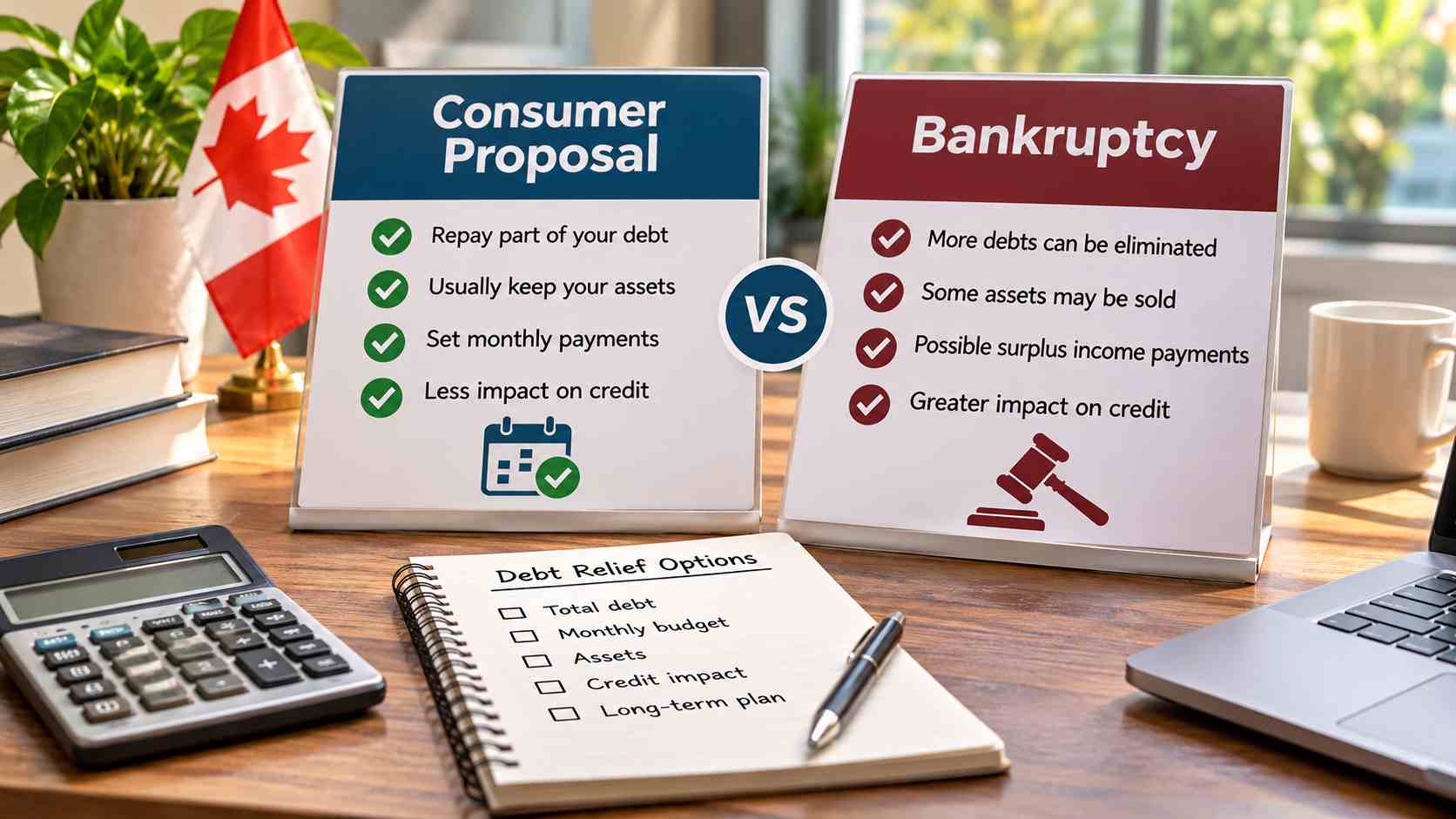
Key Takeaways
- A consumer proposal involves negotiating an affordable repayment offer, while bankruptcy follows a different legal process involving assets and possible surplus-income payments.
- A consumer proposal generally lets you retain your assets, but secured creditors keep their rights over collateral.
- Both options affect credit history, and some obligations, including certain student loans and support payments, may survive the process.
Consumer Proposal vs Bankruptcy in Canada: What Is the Difference?
A consumer proposal and bankruptcy are two legal debt-relief options available under Canada's Bankruptcy and Insolvency Act. Both can help individuals deal with debts they cannot reasonably repay, but their financial consequences are different.
A consumer proposal allows you to offer creditors repayment of part of what you owe, usually through an agreed payment schedule. Bankruptcy is a formal insolvency process in which non-exempt assets may be used to repay creditors, and eligible remaining debts can be discharged after you meet the legal requirements.
Both processes must be administered by a Licensed Insolvency Trustee (LIT). An LIT reviews your financial situation and explains which options may be available.
Consumer Proposal vs Bankruptcy: Key Financial Differences
| Financial factor | Consumer proposal | Bankruptcy |
|---|---|---|
| Debt repayment | Repay an agreed portion | Depends on assets and income obligations |
| Assets | Generally retained | Non-exempt assets may be surrendered |
| Monthly payments | Set by accepted proposal | May include surplus-income payments |
| Maximum duration | Five years | Depends on circumstances and discharge requirements |
| Credit report | Generally removed three years after completion or six years after signing, whichever comes first | Usually six years after discharge; longer in some provinces |
| Administration | Licensed Insolvency Trustee | Licensed Insolvency Trustee |
These are general comparisons. The outcome depends on your financial circumstances, applicable exemptions and the terms of the process.
How Much Debt Do You Have to Repay?
With a consumer proposal, you do not automatically repay the full amount owed. Your LIT helps prepare an offer based on your income, expenses, assets and financial circumstances. Creditors consider the proposal, and accepted terms become legally binding.
An individual can generally file a consumer proposal when total debts do not exceed $250,000, excluding debts secured by the principal residence. A different limit applies to certain business-related proposals.
Bankruptcy does not use the same $250,000 ceiling. Instead, the financial impact depends partly on the value of non-exempt assets and whether your income creates surplus-income obligations.
For example, someone earning a stable income may be able to offer creditors a manageable monthly amount through a proposal. Someone with very limited income and few non-exempt assets may find bankruptcy more practical. Neither example guarantees a particular result.
What Happens to Your Income and Monthly Budget?
A consumer proposal usually provides more payment predictability. Once creditors accept the proposal, you make the agreed payments through your LIT. Your payment amount is not automatically increased just because your income rises.
Bankruptcy works differently. Your LIT reviews your household income and expenses under the applicable surplus-income rules. If your income exceeds the applicable standard, you may have to contribute part of the surplus toward your bankruptcy.
This means two people with similar debts could face very different payment obligations. Household size, income, expenses and the length of the bankruptcy can all influence the calculation.
Will You Lose Your House, Car or Other Assets?
This is one of the most important differences.
In a consumer proposal, you generally keep your assets, provided you continue meeting payments to secured creditors. However, this does not erase a mortgage, vehicle loan or other secured obligation. The lender may still have rights over the property used as collateral.
In bankruptcy, certain non-exempt assets may have to be surrendered to your LIT for the benefit of creditors. Federal rules identify some protected property, but provincial and territorial exemptions determine important details, including protections for certain household goods, vehicles and home equity.
Registered retirement savings and pension protections also have specific rules and exceptions. Do not assume every investment or savings account is automatically protected.
Before choosing either option, ask your LIT to review your home equity, vehicle ownership, savings, investments and other property.
How Long Does Each Option Affect Your Credit?
Both processes can make borrowing more difficult, but their credit-report timelines differ.
According to the Financial Consumer Agency of Canada, a consumer proposal is generally removed from credit reports three years after completion or six years after signing, whichever happens first.
A first bankruptcy is generally removed six years after discharge. TransUnion applies a seven-year period in Newfoundland and Labrador, Ontario, Prince Edward Island and Quebec. Multiple bankruptcies can remain on a report for 14 years.
These reporting periods do not mean your credit score will automatically recover when the record disappears. Lenders may consider your income, payment history, current debt and overall financial stability when reviewing future applications.
Which Debts May Not Disappear?
Neither process eliminates every possible financial obligation.
Certain debts are excluded from discharge under the Bankruptcy and Insolvency Act. These include court-ordered support payments, certain fines and penalties, and some debts arising from fraud.
Student loans have a specific rule. Government student loan debt generally remains payable if bankruptcy begins within seven years after the borrower stops being a full-time or part-time student. A court may grant relief under certain hardship conditions after five years, subject to legal requirements.
Secured debts also need separate attention because creditors may retain rights over collateral. Always ask your LIT which obligations would remain after the process.
TwikUp's Perspective
Losing a job can make existing debt obligations harder to manage, especially when regular income stops but loan payments and household expenses continue. For someone considering a consumer proposal or bankruptcy after employment loss, a severance payment may also affect the financial decisions they make during this period.
Before deciding how to use a termination payment, understand its tax treatment and how much money you may actually receive. Read our guide on Severance Pay Tax in Canada: How Much Will You Keep After Tax? to learn how severance is classified, what deductions may apply and how to estimate your take-home amount.
How Should You Choose Between the Two?
Start with a complete list of your debts, income, monthly expenses, property and secured loans. Then discuss the available options with a Licensed Insolvency Trustee before signing an agreement or making a filing decision.
The right solution is the one that addresses your debt while leaving you with a realistic path toward financial stability. It should not be chosen simply because one option sounds less serious or promises a faster result.
Disclaimer
This article provides general educational information about Canadian insolvency law and debt-relief options. It is not legal, financial or insolvency advice. Eligibility, asset exemptions, repayment obligations and discharge outcomes depend on individual circumstances and applicable federal and provincial or territorial laws. Consult a Licensed Insolvency Trustee for an assessment of your situation.