
Key Takeaways
- Bill 21 is valid: the Supreme Court held the notwithstanding clause has no substantive limits beyond the requirements in section 33's own text.
- Section 8 of Bill 21 falls only as it applies to MNAs — barring an elected member who wears a face covering infringes section 3 democratic rights, which the override cannot touch.
- The Court made no declaration that Bill 21 is inconsistent with the Charter, and dismissed both the school board's appeal and Quebec's cross-appeal.
The top court ends the Bill 21 fight — almost entirely in Quebec's favour
The Supreme Court of Canada ruled on November 27 that Quebec's Bill 21, the law barring many public servants from wearing religious symbols at work, is valid — because Quebec used the notwithstanding clause properly, and that power, the Court said, "is not subject to any limit other than those expressly set out in the provision's text." Reaffirming its 1988 Ford decision, the Court held that only the formal requirements written into section 33 of the Charter constrain a legislature that invokes it. Six of the seven judges agreed Quebec validly used both the federal override and section 52 of Quebec's own Charter.
The Court also closed the other doors the challengers tried. Section 28's gender-equality guarantee, it said, guides interpretation but creates no stand-alone right that can strike the law down. Bill 21 does not infringe section 23 minority-language education rights — the English Montreal School Board had argued it could not recruit and retain some staff, but the Court found it was not shown that this undermines the linguistic and cultural interests section 23 protects. The law also survives on division-of-powers and pre-Confederation grounds. Both the school board's appeal and Quebec's cross-appeal were dismissed.
The one provision that falls
All seven judges agreed on a single exception: section 8 of Bill 21 infringes section 3 democratic rights as it applies to members of the National Assembly. Section 3 protects the right to vote and to seek election — and section 33 cannot override it. An elected member whose religious beliefs require a face covering cannot be barred from sitting in the Assembly and taking part in the legislative process. The judges split, though, on a related question: four said courts can declare a law inconsistent with the Charter even when the override is used, but the Court made no such declaration in this case.
The Twikup Take
This is the ruling premiers across Canada were waiting for: the notwithstanding clause is, in the Court's reading, nearly as powerful as its text allows, and legislatures — not judges — hold the pen. The one crack in the wall is democratic rights, which no override can touch. Expect this judgment to be quoted in every future fight over pre-emptive Charter overrides, from school policies to pronoun rules.
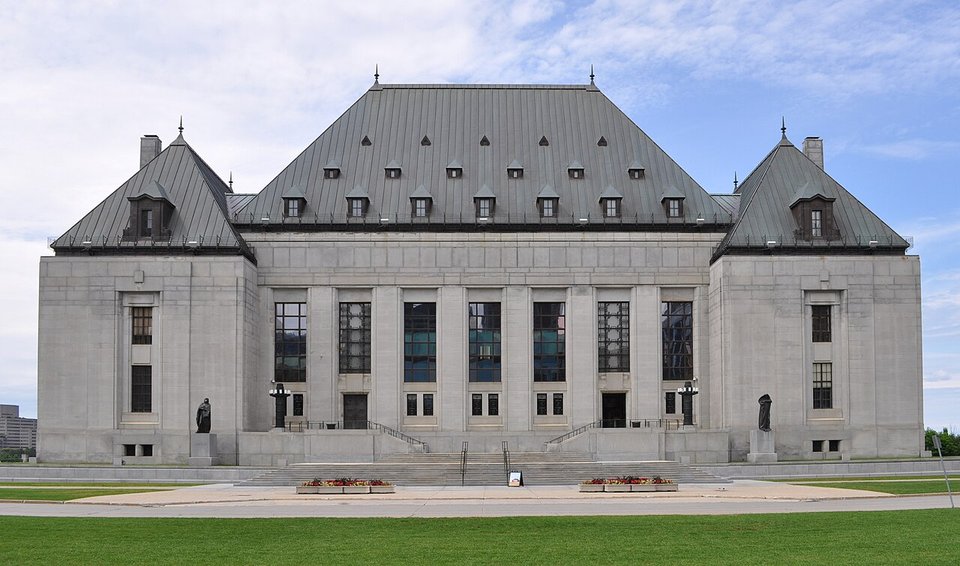
Photo: Supreme Court of Canada in Ottawa by Dig deeper, via Wikimedia Commons, licensed under CC BY 4.0.