
Key Takeaways
- Industry Minister Mélanie Joly met the CEOs of TELUS, Bell, Rogers, Eastlink, Cogeco, SaskTel and Quebecor on November 23 to discuss the future of Canada's telecom industry.
- Her statement frames telecom networks as critical to Canada's security, sovereignty and resilience, and promises Canadians "real choice,strong competition" & affordable connection.
- The statement announces no decisions, deadlines or funding — it sets the government's framing ahead of next-generation network investment.
Seven carriers, one message: connectivity is now a sovereignty issue
Industry Minister Mélanie Joly sat down with the CEOs of TELUS, Bell, Rogers, Eastlink, Cogeco, SaskTel and Quebecor on November 23, and her statement afterward was less about phone bills than about nation-building.
"Canadians deserve reliable, secure and affordable connectivity, no matter where they live," Joly said. "They also deserve to have real choice, strong competition and confidence that their data is safe and protected." Then the framing shifted: "Telecommunications infrastructure is no longer only an economic asset. It is critical to Canada's security, sovereignty and resilience."
What the statement does — and does not — do
The statement announces no decision, deadline, directive or dollar figure. It does not mention any specific company's plans or proposals. What it does is put the industry on notice about the government's priorities as AI, satellite communications and other technologies reshape networks: Ottawa says Canada "must invest in the next generation of telecommunications infrastructure" and promises a communications system "controlled in Canada, creates opportunities in Canada and works for Canadians."
The closing line sums up the pitch: "an affordable, connected and sovereign Canada, from sea to space."
The Twikup Take
Statements like this are the overture, not the opera — but the word choices matter. When an industry minister stops talking about telecom as a consumer file and starts talking about it as sovereignty infrastructure, the decisions that follow tend to favour Canadian control and domestic investment. The seven CEOs in the room heard that message directly; what they do with their prices and build plans is the part Canadians will actually feel.
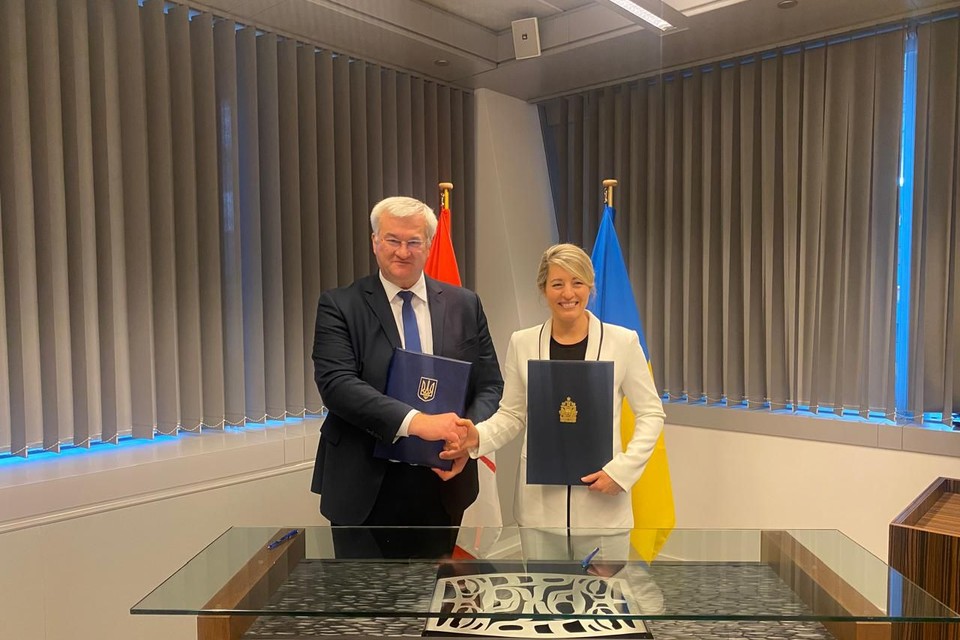
Image: Ministers of Foreign Affairs of Ukraine and Canada, Andrii Sybiha and Mélanie Joly, signed an Agreement between Ukraine and Canada on the Mutual Protection of Classified Information at NATO Headquarters by Ministry of Foreign Affairs of Ukraine, CC BY 4.0. (https://commons.wikimedia.org/wiki/File:Andrii_Sybiha_and_M%C3%A9lanie_Joly_at_NATO_headquarters_-_20241203_-_01.jpg, https://creativecommons.org/licenses/by/4.0)