
Key Takeaways
- Canada's 105 senators are appointed by the Governor General on the prime minister's advice and serve until age 75.
- Since 2016, an independent advisory board shortlists candidates — but the prime minister still makes the final choice.
- The Senate can amend or defeat Commons bills, but money bills must start in the Commons — and outright defeats are rare.
Who the 105 senators are
Imagine having the power to stop a law passed by Canada's elected politicians — without ever winning an election yourself.
That's the unusual position of Canada's Senate. Its 105 seats are divided by region, following the arrangement established at Confederation: 24 each for Ontario, Quebec, the Maritimes (Nova Scotia 10, New Brunswick 10, Prince Edward Island 4) and the West (six each for Manitoba, Saskatchewan, Alberta and British Columbia), plus six for Newfoundland and Labrador and one for each territory.
Senators are formally appointed by the Governor General — in practice, on the advice of the prime minister — and serve until mandatory retirement at age 75. To qualify, a senator must be at least 30, a Canadian citizen and a resident of the province or territory they represent.
But there's an extraordinary requirement hiding in the original 1867 rules: every senator must own real property worth $4,000 in their province and be worth at least $4,000 overall. It was a meaningful fortune in 1867. Today, it's a rounding error.
The appointment process has also changed. Since 2016, an Independent Advisory Board for Senate Appointments has run an open application process and given the prime minister a non-binding shortlist of five qualified candidates per vacancy. The final choice remains the prime minister's. Most senators appointed under the system sit as independents rather than in party caucuses.
What the Senate can — and cannot — do
Here's where things get interesting: Canada's Senate isn't just there to approve whatever the House of Commons sends its way.
No federal bill becomes law until both houses pass it in identical form. The Senate can amend Commons bills, delay them and, in principle, defeat them outright.
Its 17 standing committees handle much of the detailed clause-by-clause review. This is the institution's famous "sober second thought" role, a phrase John A. Macdonald used at Confederation.
But the Senate has important limits, particularly when money is involved.
Under section 53 of the Constitution Act, 1867, bills that spend public money or impose a tax must originate in the elected House of Commons. Senators also cannot use amendments to raise a tax or a spending charge.
Constitutional amendments come with another restriction: the Senate holds only a 180-day suspensive veto. It can delay them, but not block them.
So why doesn't the Senate routinely defeat legislation?
In practice, senators accept that the elected chamber's will takes precedence. They can scrutinize, challenge and amend legislation, but outright defeat is the rare exception.
The two times the Senate changed history
The Senate rarely uses its full power to stop legislation. But twice, its decisions produced major political confrontations.
1990 — the GST fight. A Liberal-dominated Senate obstructed Brian Mulroney's Goods and Services Tax. Rather than accept the deadlock, Mulroney reached for section 26 of the Constitution — a never-before-used power to appoint extra senators. He added eight at once, split equally among the four regions, to break the deadlock. The GST passed. Section 26 has never been used since.
1991 — the abortion bill. The following year brought an even more dramatic showdown. Bill C-43, which would have recriminalized abortion with exceptions, passed the House of Commons by nine votes. Then it reached the Senate. On January 31, 1991, senators voted 43–43. Under Senate rules, a tie is a defeat. The result? A bill that had survived the elected House died in the appointed chamber. The Library of Parliament called it an unprecedented tied vote.
The Twikup Take
Canada's Senate has a strange kind of power: it can challenge laws passed by elected politicians, but rarely chooses to bring the process to a halt.
It's designed to be a brake, not a steering wheel — an unelected chamber expected to provide independent scrutiny rather than compete with the Commons. Yet the GST battle and the tied abortion bill vote show that its influence is more than ceremonial.
Whether that arrangement is worth keeping has been debated since 1867. And somehow, the requirement that senators own $4,000 in property is still part of the conversation.
Canada's Senate rarely stops the government — but when it does, even elected politicians have to pay attention.
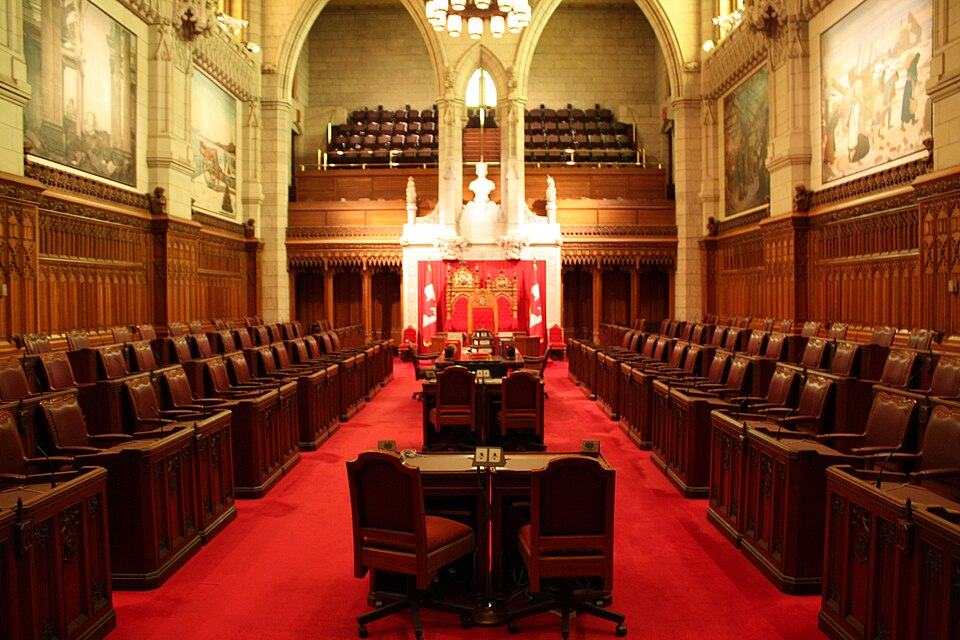
Image: The Senate chamber, Parliament Hill, Ottawa by Makaristos, via Wikimedia Commons, public domain.