
Key Takeaways
- The Canadian Armed Forces are a single unified force: every member serves under the Chief of the Defence Staff, currently General Jennie Carignan, who answers to the civilian Minis
- The force is authorized at 71,500 Regular and 30,000 Reserve members; actual Regular Force strength was 67,827 in April 2026
- Every recruit, in every uniform, starts with a nine-week basic course at Saint-Jean-sur-Richelieu, Quebec
One force, not three
Unlike the United States, Canada does not run legally separate army, navy and air force services. The Canadian Armed Forces are a single, unified force: as National Defence puts it, every member serves under the chain of command of the Chief of the Defence Staff — currently General Jennie Carignan — "regardless of their location and type of employment."
The three uniforms are real, but they are commands inside one force. The Royal Canadian Navy, the Canadian Army and the Royal Canadian Air Force are the force generators — they recruit, train and equip people for their element. The force employers that actually deploy them include Canadian Joint Operations Command, Canadian Special Operations Forces Command (CANSOFCOM), and NORAD.
Who's in charge of whom
The chain has three links, and only one of them wears a uniform at work.
At the top, the Governor General — currently Louise Arbour — serves as Commander-in-Chief of Canada, exercising the role on behalf of the King: appointing the Chief of the Defence Staff on the Prime Minister's recommendation, approving badges and insignia, signing commission scrolls and awarding military honours.
Civilian control sits with the Minister of National Defence — currently David J. McGuinty — who is responsible for the overall control and management of the department and the Forces. The Chief of the Defence Staff commands the military under the direction of the Minister. Orders flow down from the CDS; accountability flows up to Parliament.
How big is it, actually?
The authorized strength is 71,500 Regular Force and 30,000 Reserve Force members. The actual Regular Force stood at 67,827 in April 2026 — short of the target, though recruiting is at its highest in over 30 years: 7,310 people enrolled in 2025-26 against a target of 6,957, and the department says it is on track to reach 71,500 by 2029.
Ranks come in two families: commissioned officers, from Officer Cadet up to General (or Admiral in the Navy, which keeps its own rank names), and non-commissioned members, from Private — Sailor 3rd Class in the Navy — up to Chief Warrant Officer or Chief Petty Officer 1st Class.
How you join
Applicants must be Canadian citizens or permanent residents, at least 17, with Grade 10 for non-commissioned trades or Grade 12 and a degree path for officers. Everyone who is accepted, in every uniform, starts the same way: Basic Military Qualification, a nine-week course at the Canadian Forces Leadership and Recruit School in Saint-Jean-sur-Richelieu, Quebec, where sailors, soldiers and aviators train together before moving on to their element and trade schools.
Two standing promises
The Forces exist inside two alliance commitments. NORAD, established with the United States in 1958, is the world's only binational military command, defending North American aerospace with about 1,000 Canadian personnel. And Canada is a founding member of NATO, whose collective defence commitment the government's defence policy calls "the cornerstone of our national security."
The Twikup Take
The unified structure is the part most Canadians never learn: one force, one chief, one civilian minister accountable for all of it. The navy, army and air force compete for recruits and budget — but in law and in command, they take orders from the same desk.
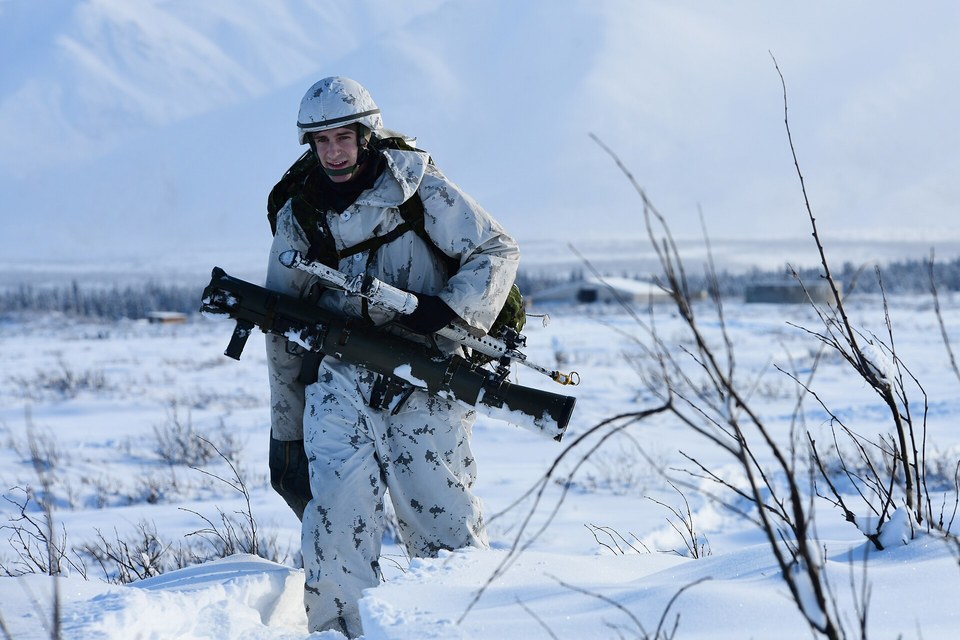
Image: A Canadian paratrooper walks off the drop zone after a joint exercise in Alaska. Photo by John Pennell, via Wikimedia Commons (public domain).