
Key Takeaways
- Spaceport Nova Scotia near Canso won provincial environmental approval in 2019 and has flown suborbital missions since 2023, but no orbital launch has ever taken place from Canadia
- The site was designed around Ukraine's Cyclone-4M rocket; after Russia's invasion, Maritime Launch's own filings say the plan proceeds on the assumption that rocket will not be ava
- In November 2026, Germany's Isar Aerospace took over a dedicated launch complex inside the spaceport and is targeting the site's first orbital launches in 2028
3,500 rockets, none of them to orbit
Canada is a spacefaring country with one odd gap: it has never launched anything into orbit from its own soil. Its historical launch activity was science, not orbit — the Churchill Research Range in northern Manitoba flew more than 3,500 suborbital sounding rockets to probe the upper atmosphere before it was decommissioned in 1989. Canadian satellites have always ridden foreign rockets from foreign pads.
The fix is being built on Nova Scotia's Atlantic coast.
The site: Canso
Spaceport Nova Scotia, developed by Maritime Launch Services, sits on about 335 acres of Crown land near the communities of Canso, Hazel Hill and Little Dover in Guysborough County — chosen because rockets can fly out over the open Atlantic toward polar and other high-inclination orbits. Nova Scotia's environment minister approved the project on June 4, 2019, construction began in 2022, and the site has flown suborbital demonstration missions since 2023.
The model is an airport: Maritime Launch operates the shared spaceport, and launch companies build and run their own dedicated pads inside it.
The rocket that never came
The spaceport was designed around one rocket: Ukraine's Cyclone-4M, a medium-class launcher from the Yuzhnoye design bureau, planned to fly up to eight times a year carrying satellites of about five tonnes.
Russia's invasion of Ukraine ended that plan. Maritime Launch's own regulatory filings state the position precisely: the company has "pivoted toward other launch vehicle suppliers" and its business plan proceeds "on the assumption that the Cyclone 4M launch vehicle will not be available for the foreseeable future." No Cyclone-4M ever flew from Canso.
The licensing gap
There is also no Canadian launch-licensing law yet — because there has never been anything to license. In January 2023, Transport Canada announced that commercial launches would be enabled under existing legislation, case by case, while a proper framework was built. A dedicated statute, Bill C-28, the Canadian Space Launch Act, was introduced in April 2026 and remains at second reading in the House of Commons. Transport Canada, not the Canadian Space Agency, is the regulator in charge.
Enter the German tenant
On November 21, 2026, at the Halifax International Security Forum, Maritime Launch and Germany's Isar Aerospace announced the handover of a dedicated launch complex inside the spaceport: Isar assumes operational responsibility for its own complex and will build a final assembly line and payload preparation facility for its Spectrum rocket. Spaceport Nova Scotia becomes Isar's second launch site in the world and its first in North America — Isar says it reached orbit in September 2026, the first European commercial company to deliver satellites there.
The joint announcement targets first orbital launches from the complex in 2028 (Maritime Launch's own site separately speaks of a late-2027 target for the spaceport's first orbital launch). Defence Minister David McGuinty, quoted in the release, called the partnership "an important step toward building a sovereign space-launch capability right here in Canada." National Defence is already an anchor customer: it signed a 10-year agreement with Maritime Launch, announced in March 2026, for Forces access to launches and research.
The Twikup Take
Canada's first orbital launch site survived its anchor rocket being cancelled by a war — by becoming a landlord. If Isar's 2028 target holds, the first satellite to leave Canadian soil for orbit will fly on a German rocket, from a Nova Scotia pad, under a licensing law that hasn't passed yet. Sovereign launch, it turns out, is a team sport.
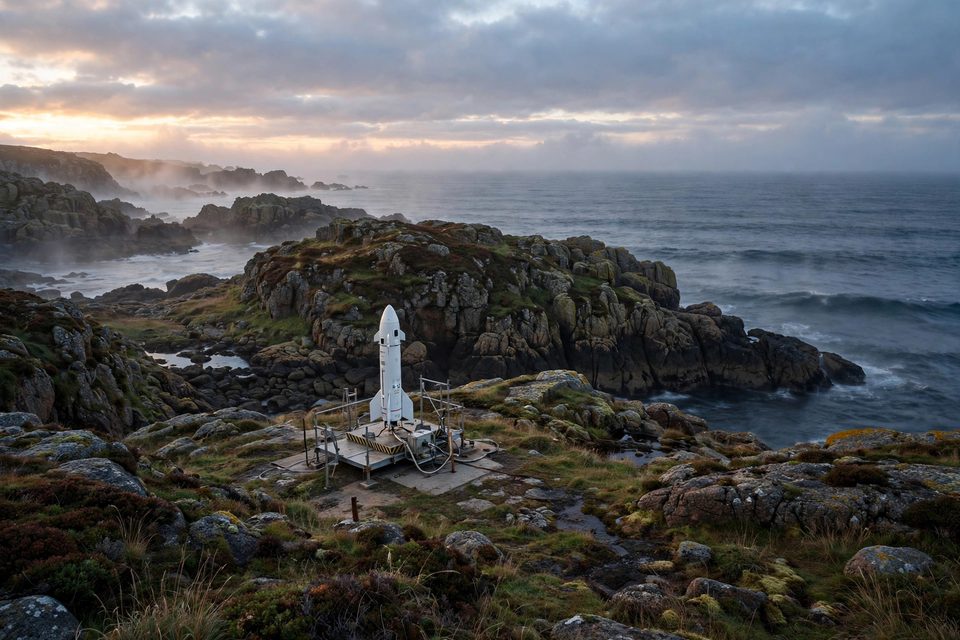
Image: Illustrative image.
Sources
- Isar Aerospace / Maritime Launch Services — Isar Aerospace starts build-out of its launch site at Spaceport Nova Scotia (Nov 21, 2026)
- Nova Scotia Environment — Canso Spaceport Facility environmental assessment
- Transport Canada — Government of Canada supports commercial space launches in Canada (Jan 20, 2023)
- Canadian Space Agency — Milestones