
Key Takeaways
- The federal government has begun recruiting commissioners for the independent Miscarriage of Justice Review Commission, created by the Act known as David and Joyce Milgaard's Law.
- The commission will have a Chief Commissioner plus four to eight commissioners, appointed for terms of up to seven years, staggered so terms do not end at once.
- Under the old ministerial system, 236 completed applications produced remedy decisions for 36 people: 16 new trials, 18 new appeals and 2 rejections.
What happens when Canada's justice system gets it wrong?
Imagine spending years in prison for a crime you did not commit — and the only person who can order a new trial is the same minister who oversees the justice system.
The federal government has begun recruiting the first commissioners of the Miscarriage of Justice Review Commission, the independent body that will take over reviewing potential wrongful convictions from the Minister of Justice.
The commission was created by the Miscarriage of Justice Review Commission Act, known as David and Joyce Milgaard's Law, which received royal assent in December 2024. It will operate at arm's length from government and independently of police, prosecutors and the courts.
Its structure is a Chief Commissioner plus four to eight commissioners, each appointed for a term of up to seven years. The terms will be staggered so that, as much as possible, the terms of more than half the commissioners do not end in the same year.
What the commission will — and won't — do
The commission will review applications from people who believe they were wrongly convicted, investigate cases and decide which ones should go back to court. It will not decide guilt or innocence, and it cannot overturn a conviction — only the courts can do that. What it can order is a remedy, such as a new trial or a new appeal.
"Wrongful convictions can have lasting consequences," Justice Minister Sean Fraser said. "We're taking the next step in establishing a commission that will review these cases independently of government."
The release gives no date for when the commission will start hearing cases. Until it opens, the existing process continues: the Criminal Conviction Review Group inside the Justice Department keeps assessing cases, and the minister keeps ordering new trials or appeals under the Criminal Code — an authority that has existed in some form since 1892.
The record of the system it replaces
236 applications. 36 decisions. A slow drip for people who say the courts got it wrong.
Over the 24 years of the current regime, the department received 236 completed applications, and the minister made remedy decisions for 36 individuals.
Of those 36 decisions, the minister ordered 16 new trials and 18 new appeals, and rejected 2 applications. Notably, 16 of the 36 decisions came in just the last five years — a sign of how much of the old system's work has been recent.
The Twikup Take
Thirty-six remedy decisions out of 236 applications over 24 years is a slow drip for people who say the courts got it wrong. An arm's-length commission won't speed every case up, but it removes the awkward reality of a cabinet minister deciding whether the justice system he oversees made a mistake.
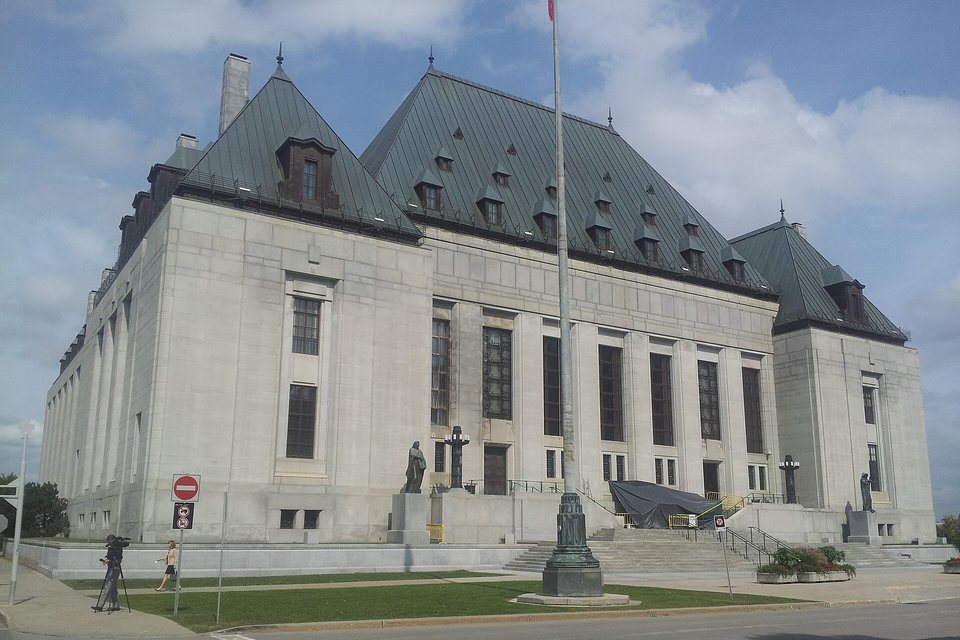
Image: Supreme Court of Canada building on Wellington Street, Ottawa by Rleir, CC BY-SA 3.0. (https://commons.wikimedia.org/wiki/File:Supreme_Court_of_Canada,_Wellington_Street,_Ottawa.jpg, https://creativecommons.org/licenses/by-sa/3.0)