
Key Takeaways
- Trump urged Canadian companies doing business with America to move to the United States, linking relocation with avoiding tariffs.
- Doug Ford said further tariff escalation could be devastating for businesses and workers in both Canada and the United States.
- The dispute could influence where companies choose to manufacture, invest and build future North American capacity.
Image Source - Donald J. Trump / Truth Social
Trump’s Message to Canadian Companies: Move
Trump made multiple Canada-related posts Sunday.
At approximately 9:55 a.m. EDT, he wrote:
“Canadian businesses are pouring into the United States. We want to make our own cars, etc. That’s what’s going to happen.”
Trump also accused Canada of having “ripped” the United States off for years.
That was a presidential claim, not evidence of a documented mass relocation of Canadian companies.
Trump did not identify companies or provide figures showing how many Canadian businesses had moved operations to the United States.
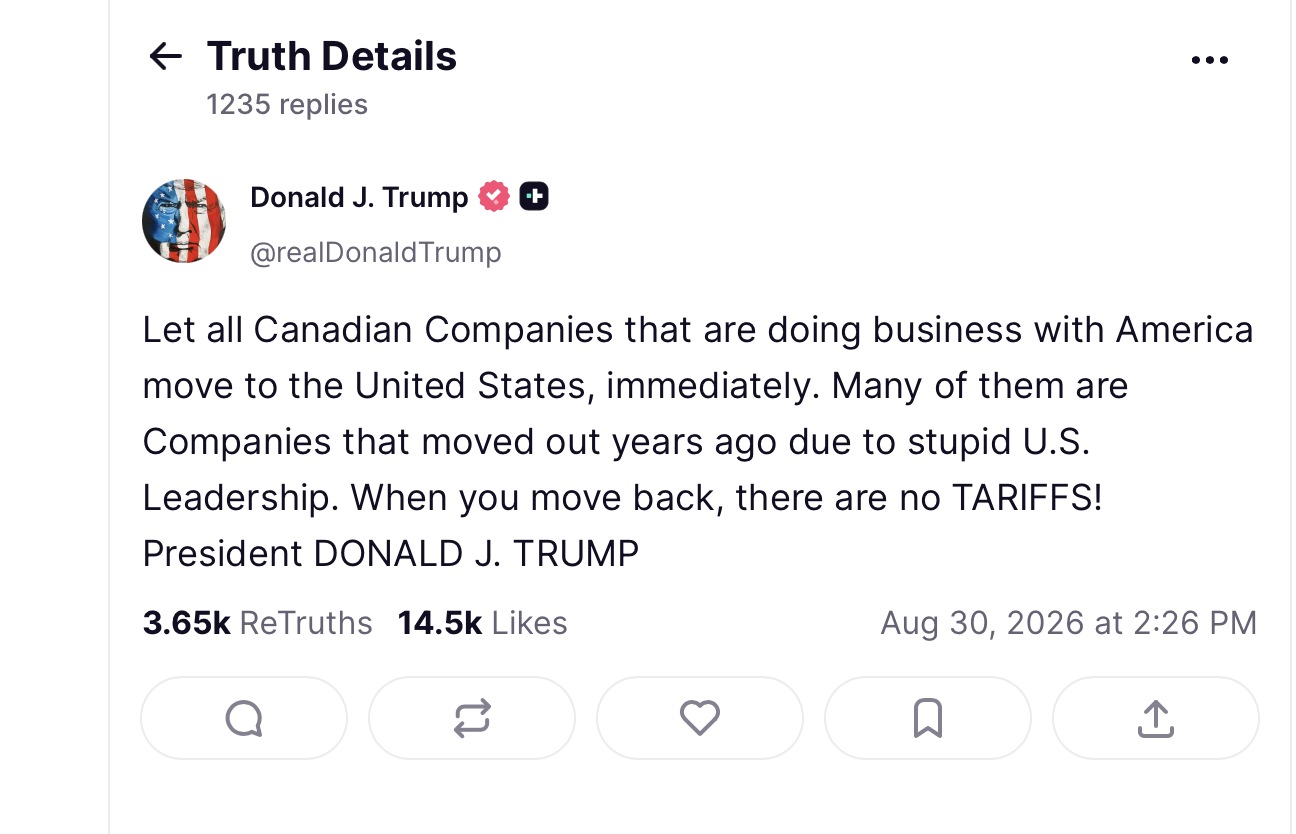
Then, at approximately 2:26 p.m. EDT, Trump went considerably further.
He called on Canadian companies doing business with the United States to relocate there immediately.
“Let all Canadian Companies that are doing business with America move to the United States, immediately,” Trump wrote.
He argued that many were companies that had left the United States years earlier and added:
“When you move back, there are no TARIFFS!”
The significance goes beyond another sharp statement about Canada.
Trump is explicitly linking tariffs with corporate location decisions.
But there is an important distinction.
Trump's post encouraged companies to move to the United States. It did not announce a new tariff exemption program specifically for Canadian companies, nor did the post provide detailed eligibility rules explaining exactly how a company could qualify for tariff-free treatment.
It should therefore be read as a presidential policy message rather than a detailed new tariff regulation.
And whether Canadian businesses respond to that invitation on a meaningful scale remains another question entirely.
The Auto Industry Is at the Centre of the Fight
Canada and the United States do not operate completely separate automobile industries.
Vehicles and their components can cross the border during the manufacturing process, making the North American automotive supply chain highly interconnected.
That integration is one reason tariffs can become complicated quickly.
The White House significantly escalated the dispute this summer.
In a July 20 presidential proclamation, Trump said Canada’s tariff treatment of U.S. motor vehicles discriminated against American commerce.
The proclamation noted that Canada had maintained a 25% tariff on U.S. motor vehicles that did not qualify for preferential duty-free treatment under the United States-Mexico-Canada Agreement, while applying tariffs to certain non-Canadian or non-Mexican content in qualifying U.S. vehicles.
The White House also objected to Canada’s use of tariff-rate quotas affecting U.S. automakers.
Trump responded by ordering an additional 50% duty on certain Canadian products identified in the proclamation’s annex, with an original effective date of August 19.
That does not mean every Canadian automobile or every Canadian product automatically received an additional 50% tariff under that proclamation.
The measure applies to specified products covered by the presidential action.
The August Tariffs Were Delayed — Not Cancelled
Three days before those additional duties were scheduled to begin, Trump temporarily delayed them.
On August 18, the White House issued another proclamation saying senior administration officials had reported that Canada had expressed a commitment to address the measures disputed by Washington.
Trump therefore suspended the additional duties for three days.
The new effective date became:
12:01 a.m. EDT on August 22, 2026.
That distinction is important because another tariff issue is now hanging over the auto industry.
During Ford’s August 30 ABC interview, Martha Raddatz asked the premier about Trump’s threat to increase tariffs affecting Canadian auto imports, including cars, trucks, auto parts and steel, from 25% to 50% beginning January 1.
That January threat should not be confused with the separate 50% additional duties on specified Canadian products that took effect August 22.
They are related parts of the broader trade confrontation, but they are not the same measure.
Doug Ford Says Both Countries Could Pay the Price
When Raddatz asked Ford what a move from 25% to 50% on those Canadian imports would mean, his answer was direct:
“Well, it’d be devastating on both countries.”
Ford went further, arguing that the consequences could also be significant for the United States because Canada purchases large amounts of American vehicles and steel.
He told ABC that a tariff on Canada is, in his view, effectively a tax on Americans.
That is Ford’s economic and political argument — not a guaranteed outcome for every tariff, company or consumer.
But it captures the central Canadian response to Trump’s strategy.
Canada and the United States have spent decades building supply chains that cross the border.
A manufacturer operating in Michigan can rely on materials or components from Ontario.
A Canadian factory can rely on American suppliers.
Tariffs imposed at the border can therefore affect businesses operating far away from the border itself.
Ford Says Canada Still Wants a Deal
The trade confrontation has also become increasingly personal.
Raddatz noted that Trump had called Ford a “flunky,” while Ford had publicly responded with insults of his own.
Ford acknowledged that the exchange had become heated.
But during Sunday’s interview, he shifted the focus back toward reaching an agreement.
“We need to focus on a free trade agreement that will create more jobs, more opportunities on both sides of the border,” Ford said.
Ford repeatedly argued that free and open trade helped build the economic relationship between Canada and the United States.
He also stressed that despite the political confrontation, Canadians distinguish between their disagreement with Trump and their relationship with Americans more broadly.
Near the end of the interview, Ford described Canada and the United States as allies whose trade is highly integrated.
His closing message was considerably more conciliatory:
“God bless America. God bless Canada.”
Then came the part that matters economically:
“Let’s get a deal and let both countries prosper.”
This Is Becoming a Fight Over Where Companies Invest
Tariff disputes can sound abstract.
A government announces 25%.
Another announces 50%.
Politicians argue about trade deficits, market access and unfair treatment.
But underneath those percentages is something much easier to understand:
Where will companies build their next factory?
That is where Trump’s August 30 message becomes particularly significant.
By explicitly telling Canadian companies to move to the United States and linking relocation with avoiding tariffs, Trump is framing tariffs not only as a border tax but also as a tool to encourage investment inside America.
That does not mean Canadian factories are suddenly preparing to move south.
There is currently no evidence in Trump’s August 30 posts demonstrating a large-scale migration of Canadian companies into the United States.
But the incentive Trump is trying to communicate is clear.
For a company selling heavily into the American market, the location of production could increasingly become part of its tariff calculation.
Moving a Factory Is Not Like Moving an Office
There is another reality that political rhetoric can obscure.
Moving industrial production is enormously complicated.
An automotive plant represents far more than a building.
It can involve billions of dollars of investment, specialized machinery, trained workers, supplier networks, transportation infrastructure, energy contracts and long-term agreements.
Suppliers may themselves depend on other suppliers located across the border.
A company considering a new factory may therefore respond to tariff policy differently from a company deciding whether to relocate an existing plant.
That is why the most important consequences of the trade fight may take years to become visible.
The immediate question is not simply whether companies shut Canadian factories tomorrow.
It is whether the next round of investment begins shifting.
Why Ontario Has So Much at Stake
For Ford, that question is particularly important because Ontario sits at the centre of Canada’s automotive manufacturing industry.
Its factories are closely connected with American manufacturing operations, particularly across the Great Lakes region.
That means disruption can travel in both directions.
A Canadian plant may depend on an American supplier.
An American assembly plant may depend on Canadian-made components.
That creates the contradiction at the heart of the current dispute.
Trump wants more manufacturing located inside the United States and argues tariffs can help achieve that objective.
Ford argues that the existing Canada–U.S. economic relationship already supports jobs and businesses on both sides of the border — and that disrupting it could damage both countries.
Those two visions are increasingly colliding.
What Happens Next?
The biggest question now is not what Trump or Ford says next.
It is what companies actually do.
Several developments will be particularly important to watch:
- Canadian manufacturers announcing new or expanded U.S. production;
- companies delaying, reducing or redirecting planned Canadian investment;
- new automotive or parts-manufacturing commitments in either country;
- further changes to Canadian or American tariff measures;
- the threatened January 1 tariff increase; and
- any renewed trade negotiations between Ottawa and Washington.
A single corporate relocation would not prove that Canadian industry is broadly moving south.
But if multiple manufacturers begin citing tariffs when choosing the United States over Canada for new factories or investment, the trade confrontation would start producing measurable changes in the geography of North American manufacturing.
For now, the confirmed development is simpler.
The president of the United States is openly telling Canadian companies doing business with America to move south — and explicitly connecting that move with escaping tariffs.
TwikUp Insight
The most important word in Trump’s August 30 message may not be tariffs.
It may be move.
Tariffs normally change the cost of moving goods across a border.
Trump is trying to use them for something bigger: influencing where companies choose to operate, manufacture and invest.
That changes the stakes of the Canada–U.S. trade fight.
For Canada, the longer-term concern is not simply whether exporters pay higher duties this year.
It is whether companies making decisions about their next factory, production line or billion-dollar investment conclude that locating more capacity inside the United States gives them a safer route to the American market.
But that outcome is not predetermined.
North American manufacturing networks have been built across borders over decades, and relocating them can be expensive, slow and operationally difficult.
Trump has now made his preferred direction unmistakable.
Ford has made Ontario’s counterargument equally clear: the two economies are already deeply intertwined, and damaging one side can create consequences on the other.
The real scoreboard in this trade fight may therefore not be the number of political statements or even the headline tariff rate.
It may eventually be measured by something much more permanent:
where the next factory gets built.