
Key Takeaways
- The Bank of Canada's third-quarter Market Participants Survey puts the median policy-rate forecast at 2.50% by December 2026 and 2.75% by March 2027, then flat through 2028 — with
- Respondents see inflation ending 2026 at 3.0% before returning to 2.0% by the end of 2027.
- Recession odds stay low, peaking at a median 23% in 12 to 18 months.
The Market's Verdict: Two More Hikes, Then a Long Hold
Financial markets are not betting on relief from the Bank of Canada just yet. Instead, their latest forecasts point to two more interest rate increases before the central bank settles in for a long pause.
The Bank's third-quarter Market Participants Survey, published November 9, puts the median forecast for the policy interest rate at 2.50% by December 2026 — one more quarter-point hike — rising to 2.75% by March 2027. Respondents expect it to remain there through the end of 2028.
The survey, answered by about 25 financial market participants, also reveals where they see the bigger risk. 52% say the risks around their rate forecasts are tilted towards a higher path, while not one respondent sees the risks tilted lower. Their estimated long-term neutral rate — the level that neither stimulates nor restrains the economy — sits at a median of 2.75%, exactly where they expect the Bank's rate to settle.
Inflation: One More Year Above Target
Inflation is another reason markets aren't rushing to celebrate. Respondents see headline inflation ending 2026 at a median of 3.0% — the upper edge of the Bank's 1–3% control range — before dropping to 2.0% by the end of 2027 and remaining there five years out.
But getting there could be uncomfortable. Participants assign a 42.5% average probability to inflation ending 2026 somewhere between 3.01% and 4.00%, with a further 5.9% probability of it exceeding 4%.
Growth expectations offer a more measured picture. Respondents forecast median real GDP growth of 1.6% by the end of 2026 and 1.8% by the end of 2027. An overwhelming 92% believe the Canadian economy is currently operating below its potential.
Recession risks haven't disappeared, either. Respondents put the median probability of a recession at 13% within six months. That rises to 23% in the 12-to-18-month window before easing back to 20%.
Trade Tensions Dominate Everything
For financial market participants, Canada's biggest economic wildcard isn't difficult to identify: trade.
An increase in trade tensions tops the downside risks, named by 88% of respondents. Tighter monetary policy and tighter global financial conditions follow, each cited by 52%.
The upside picture tells almost the same story in reverse. An easing of trade tensions is the leading positive risk, also named by 88%, followed by larger-than-expected fiscal stimulus at 72%.
Their market forecasts offer another snapshot of what lies ahead. The median respondent expects the Canadian dollar to reach US$0.72 by the end of 2026, West Texas Intermediate oil to trade at US$90 a barrel, and the 10-year Government of Canada bond yield to stand at 3.90%.
The Twikup Take
Markets are sketching out a fairly clear path for the Bank of Canada: one hike by December, another by March, followed by a prolonged hold at 2.75%. But the more revealing signal is the direction of the risks. More than half of respondents see those risks tilted towards higher rates, and nobody sees them tilted lower.
For borrowers hoping interest rates will fall, the latest survey offers little encouragement: the market's central forecast points to two more hikes, not relief.
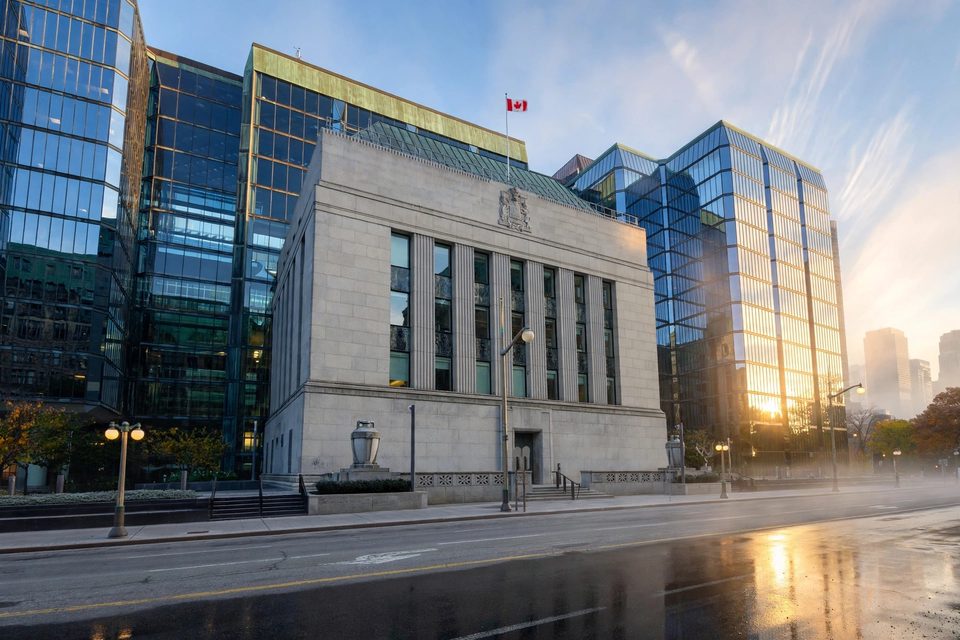
Image: Illustrative image.