
Key Takeaways
- Canadian farm cash receipts passed $100 billion for the first time in 2025, reaching $102.1 billion in the 100th year of the series.
- Realized net farm income rose just 2.5% to $8.6 billion, because operating expenses climbed almost as fast as receipts; excluding cannabis, net income rose 11.7% to $9.9 billion.
- Cattle drove the year: livestock receipts rose 13.6% to $45.4 billion while crop receipts were nearly flat and program payments fell 18.2%.
A record top line, a thin bottom line
Canadian farms took in $102.1 billion in cash receipts in 2025, up 4.5% — the first time receipts have crossed $100 billion in the century-long history of the series. But realized net farm income rose only 2.5%, to $8.6 billion, because operating expenses climbed 4.6% to $82.6 billion alongside the revenue. Excluding cannabis, realized net income rose 11.7% to $9.9 billion, and total net income (which counts inventory changes) rose $5.1 billion to $13.6 billion.
Cattle carried the year
Livestock receipts jumped 13.6% to $45.4 billion, their fifth straight increase. Cattle and calves alone brought in $20.7 billion, up 23%, on prices up 24.2% — even as the number of cattle slaughtered fell to its lowest in nearly a decade. Hog receipts rose 13.8% to $7.2 billion, and the supply-managed sector added 3.3% to reach $15.7 billion.
Crop receipts, by contrast, were nearly flat at $51.9 billion (+0.1%): record yields met lower prices, and canola receipts fell 6.4% as exports dropped 12.5% under trade restrictions — even as domestic canola crushing hit a record high.
The squeeze underneath
Two expense lines tell the story of the thin margin. Livestock and poultry purchases soared 39.3% to $6.2 billion — the largest increase since 1981 — as farmers paid record prices for cattle. And government support shrank: direct program payments fell 18.2% to $4.8 billion, with crop insurance payments down 26.9%, partly offset by AgriStability payments jumping 50.6% to $905.1 million.
Provincially, Saskatchewan remained the largest earner but saw realized net income fall by about $1.0 billion on weaker crop receipts, while Quebec posted the largest gain, up $552.6 million. British Columbia, Nova Scotia and Newfoundland and Labrador all recorded negative realized net income.
The Twikup Take
A $102-billion year that leaves farmers 2.5% ahead is the modern farm economy in one line: revenue records, margin reality. The money is moving through farms faster than ever — to cattle sellers, input suppliers and lenders — while the share that stays on the farm depends more than ever on which province, and which commodity, you are in.
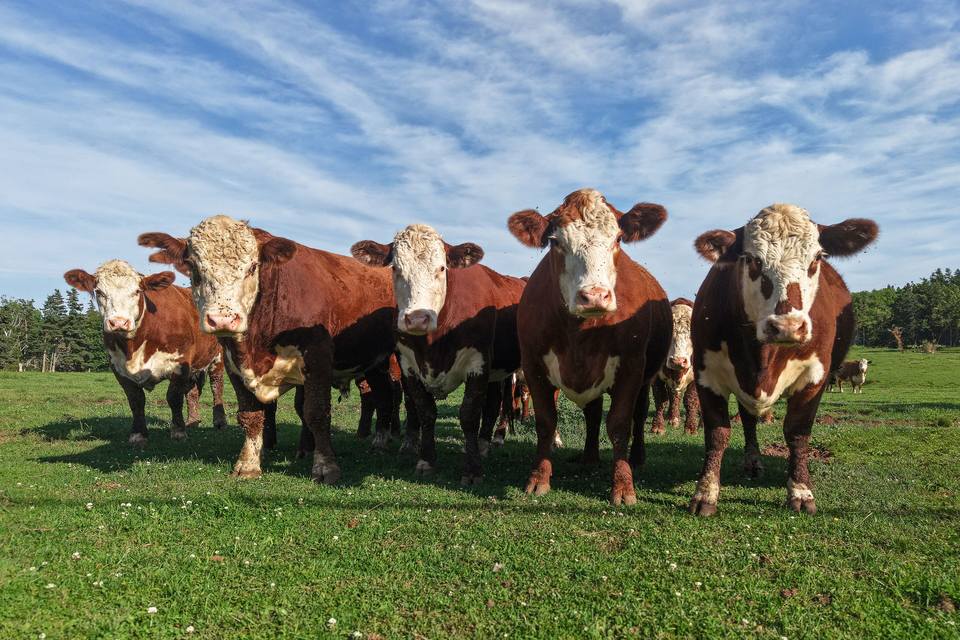
Image: A herd of Hereford cattle in a pasture in Bothwell, Prince Edward Island. by Quintin Soloviev, CC BY 4.0. (https://commons.wikimedia.org/wiki/File:Herd_of_Hereford_cattle_in_Canada.jpg, https://creativecommons.org/licenses/by/4.0)