
Key Takeaways
- In Phnom Penh on Monday, Mark Carney said Canada could work with Chinese, European or Japanese automakers if US talks fail to preserve an integrated North American auto industry.
- Asked if Chinese investment was leverage against Washington, Carney answered: "It's not leverage. But action, reaction."
- Any Chinese investment would have to mean real manufacturing in Canada — "not just about kit cars" — building on January's deal that cut the tariff on Chinese EVs from 100% to 6.1%
"It's not leverage. But action, reaction" — Carney lays out Canada's auto Plan B in public
Prime Minister Mark Carney says Canada may turn to Chinese automakers if trade negotiations with the United States fail to preserve an integrated North American auto industry.
He made the remarks on Monday to reporters in Phnom Penh, Cambodia, where he was attending the Francophonie summit. The comments came ahead of a planned meeting this week in Shenzhen with Chinese President Xi Jinping, where auto manufacturing is expected to be discussed.
Carney framed the US talks as still his priority — but not his only option.
"We have the best auto workers in the world, and we want them fully deployed, full opportunity, in an integrated North American market," he said. "That market has become less integrated because of U.S. trade actions."
If Canada's workers and plants are "not fully utilized in a North American context, that provides other opportunities," he added — with European and Japanese automakers also in the frame.
"Canada is going to move forward either way."
Asked directly whether the prospect of Chinese investment was leverage in the Washington negotiations, Carney rejected the word: "It's not leverage. But action, reaction."
Any Chinese investment, he said, would come with conditions: substantial manufacturing in Canada rather than simple assembly of imported parts, proper labour standards, and domestic supply chains that expand over time, including Canadian critical minerals for electric vehicles.
"It's not just about kit cars," he said. "There has to be a manufacturing aspect involved."
In other words, Canada wants factories, jobs and a stronger domestic supply chain — not just vehicles assembled from imported components.
The remarks build on the agreement the two leaders reached in January, under which Canada reduced its 100 per cent tariff on Chinese electric vehicles to 6.1 per cent, initially allowing up to 49,000 vehicles a year, with the cap rising over time. In exchange, China lowered tariffs on Canadian agricultural products, including canola.
Carney had set the same bottom line on Saturday in Manila: any trade agreement with Washington must leave Canada with a viable auto industry. He said he had spoken at length with President Trump and that the two countries were making progress, although differences remained.
The Twikup Take
This is the loudest version yet of Canada's two-track auto strategy: negotiate with Washington as the preferred partner, while making sure Beijing — and Washington — can both see the alternative being prepared. Carney insists it is not leverage. Announced to reporters, on the record, the week he flies to meet Xi, it does not need to be called leverage to work like it.
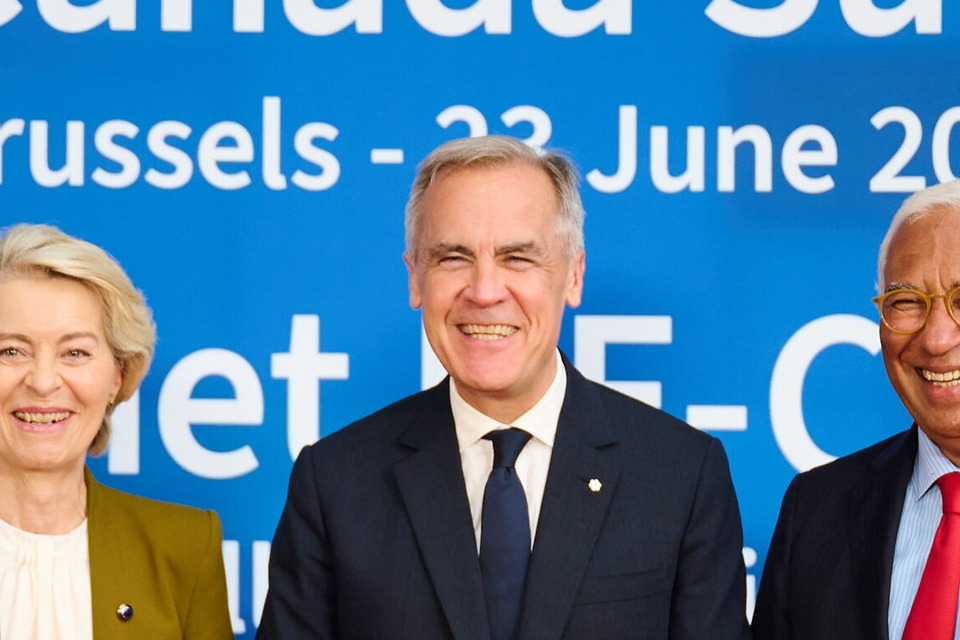
Image: Mark Carney at the 20th EU-Canada Summit in Brussels, June 23, 2025. Photo: Dati Bendo / European Union, CC BY 4.0.