
Key Takeaways
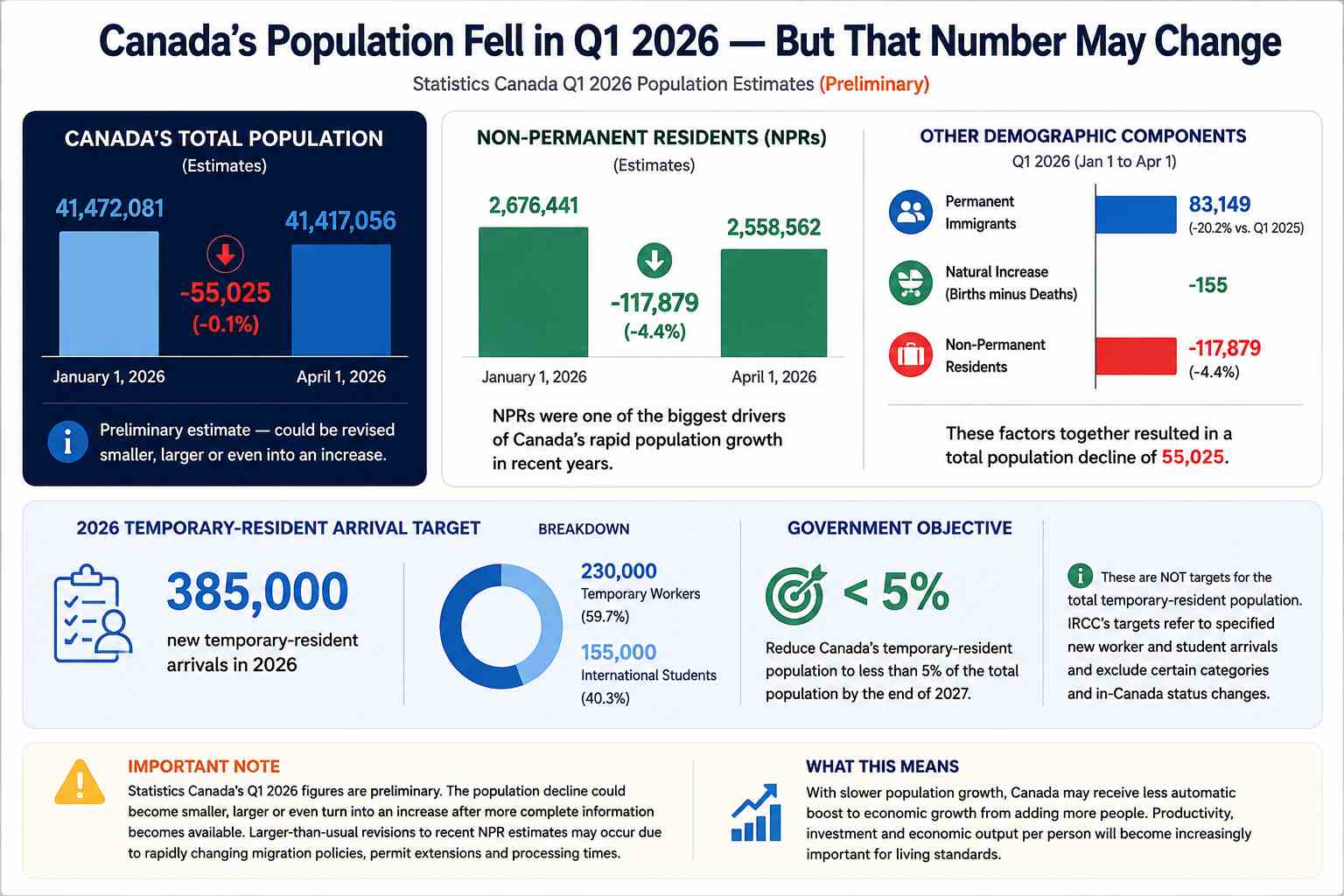
- Canada's preliminary population estimate fell by 55,025 people in Q1 2026, to 41,417,056 on April 1.
- The non-permanent-resident population fell by 117,879 people in one quarter, reaching about 2.56 million.
- Slower population growth increases the importance of productivity, investment and GDP per person for living standards.
Canada's Population Fell in the Official Estimate — But That Number May Change
The headline number doesn't look dramatic at first.
Canada's estimated population stood at 41,417,056 on April 1, 2026.
Three months earlier, there were 55,025 more people.
That's a decline of just 0.1%.
But look underneath that number and the demographic shift becomes much clearer.
Statistics Canada estimated there were 2,558,562 non-permanent residents in Canada on April 1 — down 117,879 in a single quarter, or 4.4%.
That's significant because non-permanent residents had been one of the biggest drivers of Canada's unusually rapid population growth in recent years.
The NPR decline wasn't the only demographic force at work.
Canada welcomed 83,149 permanent immigrants during the first quarter, down 20.2% compared with the same quarter a year earlier. Natural increase — births minus deaths — was also slightly negative, at -155.
And the broader slowdown isn't happening entirely by accident.
Ottawa Is Intentionally Hitting the Brakes
The federal government has been recalibrating immigration levels, particularly on the temporary-resident side.
For 2026, Ottawa's target is 385,000 new temporary-resident arrivals.
That includes:
230,000 temporary workers and 155,000 international students.
The government has also said it intends to reduce Canada's temporary-resident population to less than 5% of the total population by the end of 2027.
But there is an important distinction.
Those 385,000 arrivals are not a target for Canada's total temporary-resident population.
IRCC's temporary-resident targets refer to specified new worker and student arrivals. They do not simply represent every temporary resident already living in Canada, and the framework excludes certain categories and in-Canada status changes.
So part of Canada's demographic slowdown reflects a deliberate policy shift.
But the economic consequences are where the story becomes much more interesting.
Think of the Economy Like a Restaurant
Imagine a restaurant serves 100 customers today.
Next year, 110 people walk through the door.
The restaurant can sell more meals even if its cooks aren't faster, its technology hasn't improved and the business itself hasn't become more productive.
It simply has more customers.
Population growth can have a similar effect on an economy.
More people generally means more workers, more consumers and more economic activity.
That can help total GDP grow.
But if fewer additional people are arriving, that boost becomes smaller.
Now the restaurant needs another way to grow.
It has to become better at what it does.
For Canada, that puts much more attention on productivity: how much economic output workers and businesses can generate using the labour, technology and capital available to them.
That's Why GDP Per Person Matters
Here's the part headline economic numbers can hide.
Suppose Canada's economy grows.
Good news?
Maybe.
If the population grows even faster than the economy, GDP per person can still decline.
That's why total GDP and GDP per capita can tell very different stories.
An economy can become larger overall while economic output per person stagnates or falls.
As population growth slows, that dynamic changes.
Canada may receive less of an automatic boost to total economic growth simply from adding more people.
That puts greater emphasis on productivity, business investment and economic output per person when assessing whether living standards are actually improving.
And that's essentially the larger economic question behind CIBC's August discussion.
In an August 6 episode of Eyes on the Economy, CIBC Chief Economist Avery Shenfeld and Deputy Chief Economist Benjamin Tal discussed where Canadian population growth has been, where it may be heading and what that could mean for the country's economic-growth outlook and labour market.
But What Happens to Jobs?
Here's where slower population growth gets complicated.
Fewer newcomers can mean fewer additional workers entering the labour force.
But it can also mean fewer additional people competing for jobs.
That means slower population growth isn't automatically good or bad for Canadian workers.
What matters is what happens around it.
Are businesses creating enough jobs?
Are wages rising?
Are retiring workers being replaced?
Are companies investing in equipment and technology?
And are workers' skills matching the jobs employers actually need?
Simply knowing Canada's population is growing more slowly doesn't answer those questions.
The labour-market impact depends on how the supply of workers and the demand for workers change together.
Housing Isn't That Simple Either
The same caution applies to Canada's housing market.
Rapid population growth added substantial housing demand.
So slower population growth should, all else equal, reduce some of that additional demand pressure.
But don't translate that into:
“Population falls = house prices fall.”
Housing doesn't work that neatly.
Home prices and rents are also shaped by how much housing gets built, the amount of available supply, household formation, mortgage rates, incomes and conditions in individual cities.
A population slowdown changes one major variable.
It doesn't erase the rest of the equation.
Then Comes the Biggest Twist: What If Canada's Population Didn't Actually Shrink?
This is where the story becomes much more interesting.
Statistics Canada is very clear that its first-quarter numbers are preliminary.
The agency says the estimated population decline could eventually become smaller, become larger — or even turn into an increase once more complete information becomes available.
Statistics Canada has also warned that larger-than-usual revisions to recent non-permanent-resident estimates may occur because of rapidly changing migration policies, permit extensions, administrative information and processing times.
In other words, 41,417,056 isn't necessarily Canada's final population count for April 1.
And Benjamin Tal has raised an even broader question about how accurately Canada's temporary population can be measured.
In a March 19 CIBC Economics report, Tal argued that earlier Statistics Canada population projections substantially underestimated how large Canada's NPR population would eventually become.
His argument wasn't that Statistics Canada simply “forgot” millions of people.
It was about the difficulty of forecasting and measuring a population that can change rapidly as permits are issued, expire or get extended and as people enter, leave or remain in Canada under different circumstances.
Tal also questioned assumptions about how many temporary residents actually leave Canada after their status expires.
Canada does operate an Entry/Exit Program, so saying the country has no exit controls would be inaccurate.
The more complicated issue is determining whether administrative permit records, border information and statistical models together capture the actual number of non-permanent residents residing in Canada at a particular moment.
Someone having an expired permit, for example, isn't by itself the same thing as Statistics Canada confirming where that person currently resides.
Tal's broader argument is that uncertainty around NPR measurement can matter beyond the population count itself.
Population estimates feed into the way economists interpret indicators such as GDP per capita, productivity and labour-market conditions.
If the population denominator changes, some per-person economic measures can change as well.
But an important distinction needs to remain crystal clear:
That's CIBC's analysis. It is not an official Statistics Canada finding that millions of temporary residents have been missed or that Canada's current population estimates are wrong.
Statistics Canada builds its preliminary demographic estimates using administrative information and statistical methods, and those estimates are revised as better information becomes available.
The agency also warns against directly comparing its estimates of non-permanent residents with IRCC's temporary-resident figures because the two organizations produce their numbers for different purposes and use different concepts and methodologies.
So we know Canada's demographic direction is changing.
Exactly how quickly it is changing is harder to pin down.
TwikUp Insight
For years, exceptionally rapid population growth gave Canada's economy a powerful tailwind.
More people meant more workers.
More consumers.
More housing demand.
And more potential economic activity.
Now that tailwind is weakening.
That doesn't automatically mean Canada's economy will weaken with it.
But it does mean the country may have less room to rely on population growth alone to make the overall economy bigger.
If population growth slows substantially, Canada will increasingly need to generate growth through higher productivity, stronger business investment, better technology and greater economic output per person.
That's why the number to watch isn't only Canada's population.
Watch GDP per capita.
Watch productivity.
Watch the labour market.
And watch Statistics Canada's next population revisions.
Because the most important question isn't whether Canada's population falls by another few thousand people next quarter.
It's this:
Can Canada create stronger prosperity without relying on extraordinary population growth to make the economy bigger?
Sources
- Statistics Canada — Canada's population estimates, first quarter 2026 — June 17, 2026
- CIBC Capital Markets — Canada's population reality check — August 6, 2026
- CIBC Economics, Benjamin Tal — Should we take Statistics Canada's population projections to the bank? — March 19, 2026
- Immigration, Refugees and Citizenship Canada — Supplementary Information for the 2026–2028 Immigration Levels Plan