
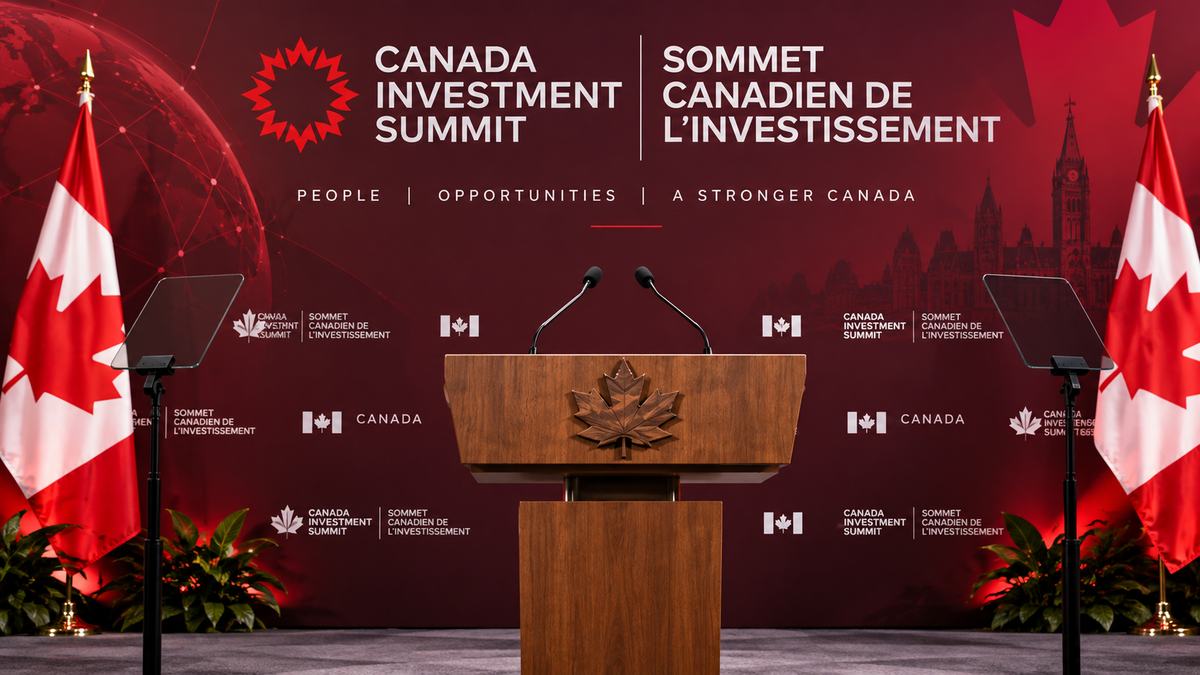
Nearly C$500 Billion in New Investment Commitments
The headline figure from the summit is nearly C$500 billion in new investment commitments.
Canada's leading pension funds, insurers and institutional investors committed nearly C$100 billion in new capital for Canadian assets.
The federal government also said Canada's top banks committed nearly C$325 billion in new financing for Canadian businesses and infrastructure.
Among the announcements, CPP Investments and Brookfield Asset Management launched a C$50 billion Maple Fund focused on critical infrastructure and strategic industries across Canada.
PSP Investments also announced plans to increase its Canadian investments by 30 to 40%, representing an additional C$25 billion.
Canada's Banks Are Putting Up Major Financing
Canada's top banks are also playing a major role in the investment push.
TD Bank announced a C$150 billion financing commitment over five years covering energy, critical minerals and resources, defence and aerospace, digital technology and artificial intelligence, and infrastructure.
Scotiabank committed more than C$100 billion in financing over five years for Canadian companies and projects.
BMO plans to invest and mobilise C$70 billion over 10 years in areas including energy, transportation infrastructure, mining, critical minerals, AI computing, defence and security.
Other commitments include CIBC financing for small and medium-sized defence-related businesses and RBC support for high-growth Canadian technology companies.
Ottawa Wants Private Investment in Four Major Airports
One of the most significant infrastructure announcements concerned Canada's airport sector.
Prime Minister Mark Carney announced that the federal government will seek private investment through long-term concessions to operate Canada's four largest airports.
The government says it will continue to own the underlying land and assets.
Instead, private capital would be brought into airport operations and growth.
Ottawa says the tens of billions of dollars of capital raised through the arrangements would be reinvested in regional airports, transportation infrastructure and other nation-building projects.
That could include a sovereign broadband backbone designed to connect Canadians across the country and to international markets.
What Is the Productivity Mega Deduction?
The government also announced a change to Canada's business-tax system through the Productivity Mega Deduction.
The measure would allow businesses to deduct the cost of a broader range of assets right away.
The assets named in the announcement include fibre-optic cable, mining property, oil and gas pipelines, software, research and development, computer equipment, aircraft and vehicles, patents, rail track, bridges and roads.
The government also said it is making immediate expensing permanent so businesses can recover eligible costs sooner.
Not Every Business Asset Is Covered
The announcement describes the measure as applying to a broader range of assets rather than all business property.
Businesses considering the deduction will need to assess how the rules apply to their particular investments.
Canada Wants More Investment in Strategic Industries
The investment announcements cover many of the sectors Ottawa considers strategically important.
Energy, critical minerals, defence, artificial intelligence, digital infrastructure and transportation are among the areas highlighted in the commitments.
The government also announced approximately C$140 million through the Canada Growth Fund for Generation Mining's Marathon Project in Northwestern Ontario.
The government describes the copper and palladium project as one of Canada's only fully permitted, shovel-ready critical-minerals projects.
AI Investment Is Also Expanding
Artificial intelligence infrastructure featured prominently during the summit.
Bell Canada, working with the Government of Saskatchewan, announced an expansion of the Bell AI Fabric to develop a 1.2-gigawatt AI infrastructure hub in Saskatchewan.
The government says the project represents a C$52.5 billion capital investment and is expected to create more than 4,500 jobs across construction, operations, management and related services.
The announcement highlights how Canada's investment strategy is increasingly tied to computing infrastructure and AI development.
Why the Government Is Making These Changes
Ottawa's broader objective is to encourage businesses and investors to put more capital into Canadian projects.
The federal government says the Productivity Mega Deduction will reduce the marginal effective tax rate on new business investment from roughly 13% to 6.4%.
The government argues that faster deductions can lower the after-tax cost of investment and encourage businesses to expand their operations, purchase equipment and develop new infrastructure.
The airport strategy similarly seeks to bring additional private capital into infrastructure while keeping public ownership of the underlying assets.
Canada's C$1 Trillion Investment Goal
The nearly C$500 billion announced at the summit is part of a much larger target.
The federal government is seeking to catalyse more than C$1 trillion in total investment over five years through public, private and institutional partners.
The investment summit was designed to connect international investors with Canadian businesses and major nation-building projects.
Whether all announced commitments ultimately translate into completed investments will depend on individual projects, financing arrangements, approvals and implementation.
What Happens Next?
The next phase will be turning investment announcements into actual projects.
Businesses will need to assess the new tax rules, investors will need to move forward with financing decisions, and airport authorities and the federal government will need to develop the proposed long-term concession arrangements.
The government said the Productivity Mega Deduction will make immediate expensing permanent, allowing businesses to recover eligible costs sooner.
The airport plan will also require further work with airport authorities, airlines, local governments and other stakeholders.
Bottom Line
Canada's first Investment Summit produced nearly C$500 billion in new investment commitments, alongside announcements covering airports, taxation, AI, infrastructure, defence and critical minerals.
The federal government is now trying to turn that momentum into its broader goal of more than C$1 trillion in total investment over five years.
The biggest question now is how quickly these commitments and policy changes translate into actual projects, business expansion and new investment across Canada.