
Key Takeaways
- The second Canada–China Economic and Financial Strategic Dialogue concluded in Vancouver on November 9, co-chaired by Ministers Champagne and Sidhu and Vice Premier He Lifeng.
- Three documents were signed, including a finance-ministries MOU and an OSFI–NFRA agreement creating a Financial Regulatory and Supervisory Dialogue.
- Two-way merchandise trade reached $125.7 billion in 2025, Canadian exports to China are up 41% year-to-date in 2026, and the next dialogue will be held in China.
Canada and China Shake Hands on Finance. The Real Prize Is Trade.
Three agreements were signed in Vancouver. But the bigger number is happening thousands of kilometres beyond the meeting room: Canadian exports to China are up 41% this year.
Canada and China wrapped up their second Canada–China Economic and Financial Strategic Dialogue on November 8–9 in Vancouver, bringing together Finance Minister François-Philippe Champagne, International Trade Minister Maninder Sidhu and Chinese Vice Premier He Lifeng as co-chairs.
The meetings produced three documents, each designed to strengthen financial cooperation between the two countries.
Three Agreements, Three Financial Channels
The first was an MOU on cooperation between the two finance ministries.
The second was a cooperation agreement between Canada's Office of the Superintendent of Financial Institutions (OSFI) and China's National Financial Regulatory Administration. It established a Financial Regulatory and Supervisory Dialogue, whose inaugural meeting was held.
The third was a set of terms of reference for a Financial Working Group, signed by the central banks.
The two countries also welcomed implementation of their bilateral currency swap arrangement, agreed to deepen cooperation in the G20, APEC and multilateral development banks, and confirmed that the next dialogue will be held in China.
These aren't trade contracts. They're financial channels designed to make cooperation easier between institutions in both countries.
The 41% Number That Makes This Interesting
Here's where the diplomatic conversations meet the Canadian economy.
According to the Finance release, two-way merchandise trade reached $125.7 billion in 2025, up 5.7%.
Canadian exports accounted for $35.0 billion, up 16.8%, while imports from China reached $90.6 billion.
But the latest export figure is even more striking: Canadian exports to China are up 41% year-to-date in 2026 compared with the same period in 2025.
Ottawa wants to build on that momentum. Canada's stated goal is to increase exports to China by 50 per cent by 2030.
China is already Canada's second-largest customer for agriculture, forest products and seafood, with roughly $10.2 billion in business. Chinese direct investment stock in Canada stands at $43.4 billion.
Champagne summed up the rationale:
"As two major economies with significant commercial ties, Canada and China share an interest in maintaining an open dialogue and advancing economic cooperation," Champagne said.
The Twikup Take
Three agreements, a financial working group and another dialogue planned in China. That's meaningful institutional progress, but it isn't a trade breakthrough.
The bigger story is the combination of two numbers: exports are climbing, but imports still significantly exceed exports. The same release puts the merchandise trade gap at $55 billion.
The 2030 target is the real test: can Canada turn diplomatic cooperation into substantially more business with China?
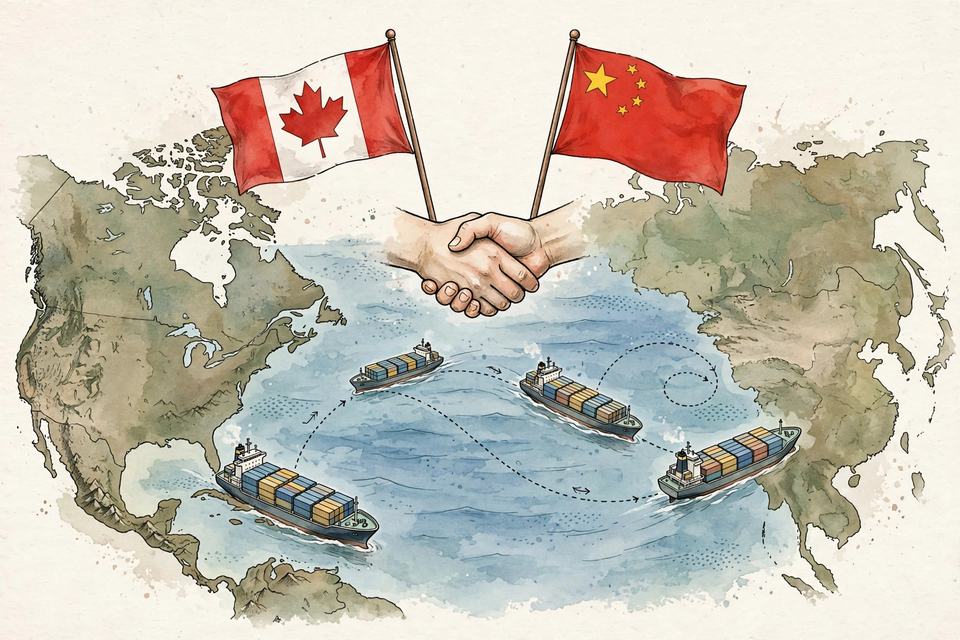
Image: Illustrative image.